
Technology is playing an increasingly important role in archaeology. Today, AI, as one of the major approaches to scientific archaeology, is continuously expanding people’s understanding of civilizations and facilitating the exploration of the evolution of Chinese civilization.
AI + archaeology: Restoring ancient landscapes and tracing historical traces
At the Sichuan Provincial Institute of Cultural Relics and Archaeology, researchers are leveraging artificial intelligence to identify the dynasties of fragmented pottery shards. An AI research team led by academicians of the Chinese Academy of Sciences and experts from the Institute of Advanced Study in Mathematics at Zhejiang University has joined hands with the Sichuan Provincial Institute of Archaeology and Chengdu Institute of Archaeology to conduct AI-based research on the pottery shards unearthed from the Baodun Site.
They have collected pottery shards excavated from the typical Phase I to Phase III sites of Baodun Ancient City – a prehistoric walled settlement, including Gaoshan, Zizhu, Mangcheng and Yufu Village sites, and built a digital AI model for pottery shard analysis. It has been confirmed that as early as more than 4,000 years ago, the ancient inhabitants of Baodun decorated their pottery with corded patterns, wave patterns and other designs.
Currently, the AI model can accurately identify the dynasties of ordinary pottery shards with severe fragmentation and limited information. The basis for dynastic dating has been extended from typical diagnostic artifacts to scattered fragmented pottery shards, providing a new tool for the rapid and simple chronological staging and dating in archaeological research.
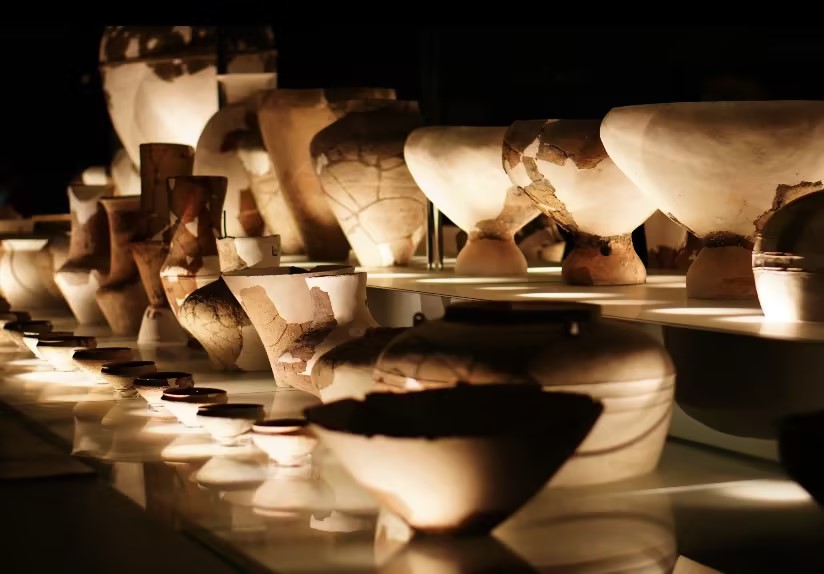
Wan Jiao, a research librarian at the Sichuan Provincial Institute of Cultural Relics and Archaeology, stated: “This data model is built on the basis of archaeological typology. It analyzes massive pottery shards and extracts a series of their features, including clay texture, clay color and decorative patterns. Its core component is a digital pottery shard collection, which generates a large volume of pottery shard data. The database records basic information of each pottery shard, and provides the data for deep machine learning algorithms for calculation.”
Modeling + archaeology: Folding time and space, reconstructing historical scenes
Nowadays, digital modeling has become a powerful tool for reconstructing ancient civilizations. The integration of archaeology and digital technology has yielded a wealth of digital archives for cultural relics and ancient buildings.
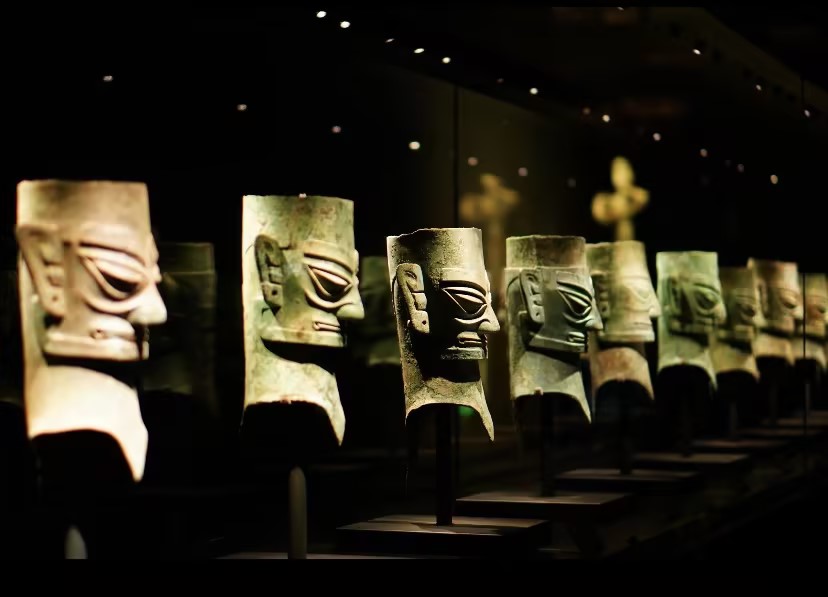
In 2025, the Sanxingdui site released the core bone-strip core bracing technology applied in the casting of large bronze artifacts for the first time. This discovery confirms that a pioneering bronze casting system took shape at Sanxingdui in the late Shang Dynasty. The system centered on piece-mold casting, and also incorporated integral casting and forging techniques. It marks the first systematic confirmation of such a technology among contemporary domestic archaeological sites. Researchers have unraveled the mystery of the exquisite bronze casting craftsmanship of ancient ancestors through micro-CT scanning and high-precision 3D modeling.
Station Master Ran, from the Sanxingdui Site Workstation of the Sichuan Provincial Institute of Cultural Relics and Archaeology, stated: “The colorful lanterns we see at temple fairs all have an internal framework. This is especially true for lanterns with more complex shapes and larger sizes. They usually have a main core bone and numerous supporting braces extending in all directions. For example, a small standing human figure wearing a pointed cap, unearthed from Pit 3 and exhibited at the Sanxingdui Museum, was cast with the core bone-strip core bracing technology. We conducted a CT scan on this figurine and detected distinct traces of the core bone and striped core bracings inside it. Clear core bones of this type have also been identified in several sacred bronze trees unearthed at Sanxingdui.”
Tracing origins + archaeology: Following the roots, knocking on the gate of history
In 2025, multiple achievements have been made in the Project for Tracing the Origins of Chinese Civilization with technological support.
Fu Qiaomei, Deputy Director of the Institute of Vertebrate Paleontology and Paleoanthropology, Chinese Academy of Sciences, noted: “Research shows that the main population of the Shimao culture originated from the local late Yangshao populations in northern Shaanxi, demonstrating clear genetic continuity. This genetically confirms the profound indigenous roots of the Shimao culture. Genetic components related to the Yumin culture of the northern steppe regions and the rice-farming agricultural populations of the southern coastal areas have been detected in a small number of individuals. This finding objectively proves that Chinese civilization has featured a grand pattern of diversity within unity and inclusiveness since its very origin.”
Archaeological research on the Liangzhu water conservancy system – China’s earliest large-scale water conservancy project – serves as another crucial evidence for the 5,000-year history of Chinese civilization. It predates the Dujiangyan Irrigation System by 2,500 years and the legendary Dayu’s flood control projects by 1,000 years. We used satellite imagery and elevation model technology to map the Liangzhu Ancient City area at a scale of 1:500. The spatial relationships of several rectangular structures on the southeastern outer side of the ancient city are clearly presented in the digital mapping.
To date, archaeologists have identified 30 dams at the Liangzhu site through excavations. The evolutionary process of the Liangzhu culture has also become increasingly clear. Over millennia, it underwent three developmental phases: constructing scattered settlements by making use of piedmont landforms, planning and building a water conservancy system, and finally constructing the Liangzhu Ancient City. This reveals an early regional state formation in the late Neolithic Age, underpinned by rice-farming agriculture, with social stratification and a unified belief system.