
Monitoring data from China’s Fengyun-3 (FY-3) satellite series shows that A23a, the world’s largest iceberg, is entering the final stage of disintegration.
True-color images with 250-meter resolution were sent back by the FY-3D satellite on January 14th. The images reveal that the main body of A23a has shrunk to only 506 square kilometers. This is less than one-eighth of its size when it calved from the Antarctic ice shelf. Just three weeks ago, the main body of this iceberg still covered 948 square kilometers.
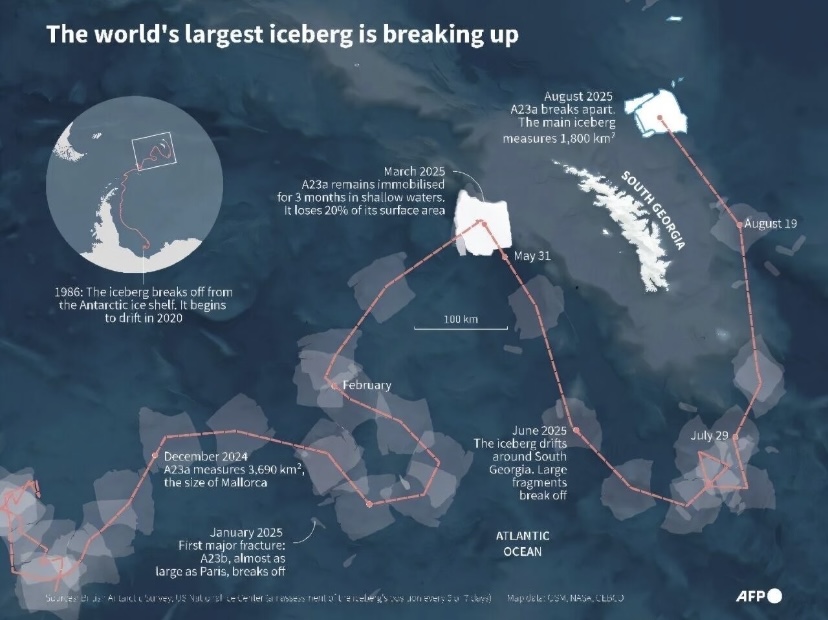
A23a covered 4,170 square kilometers when it broke away from the Antarctic ice shelf in 1986. Now its main body is only 506 square kilometers. The iceberg has drifted and grounded intermittently in the Southern Ocean for 40 years. It is now approaching the end of its disintegration.
Zheng Zhaojun is Chief Expert at the International User Service Center of the National Satellite Meteorological Center (National Space Weather Monitoring and Early Warning Center). He stated that A23a is likely to completely disintegrate within the next few weeks. Even if some remnants of the main body remain, their size will not meet the international standard for numbered icebergs. The standard is 20 square nautical miles, which is about 68.6 square kilometers. A23a is thus poised to exit the “numbered iceberg” list.
Zheng and his team used the Medium Resolution Spectral Imager (MERSI) on multiple FY-3 satellites. They have continuously tracked A23a’s drift path since 2023. They have also monitored its disintegration process since 2025. The latest monitoring results record a significant split of the iceberg earlier this year. On January 8th, the main body was still intact with only a few cracks on the surface. By January 9th, it had clearly split into four parts. Broken ice floes fell into the ocean. They quickly filled the gaps and pushed the main iceberg body and sub-icebergs apart in all directions. The splitting process accelerated in the following days. By January 14th, multiple clear water channels had formed between the main body and three major sub-icebergs. This marks their complete separation.
Zheng explained that the rapid disintegration of A23a is closely linked to the gradual development of melt ponds, ice lakes and meltwater systems on the ice surface. Satellite images clearly show a large number of blue melt ponds and lakes distributed across the iceberg’s surface. At the edges of the ice mass, meltwater causes the ice layer to heave upward. This forms structures similar to natural dams. These dams temporarily block the flow of meltwater. However, as meltwater continues to accumulate, its weight creates enormous pressure on the ice edges. This pressure is strong enough to form new cracks in the ice. Meltwater then seeps down along these cracks and erodes them further. Some water even cascades down the ice cliffs and falls directly into the sea. This process continuously scours and widens the cracks. It acts like a water wedge, splitting the ice mass bit by bit. This water-wedging effect is the key factor behind the rapid structural collapse of the iceberg.
“We are currently in the Southern Hemisphere summer,” said Zheng. “The region where the iceberg is located has relatively clear weather. Air and sea temperatures are rising steadily. Seawater above 3°C continuously erodes the ice. Ocean currents are also pushing it toward warmer northern waters. These factors are combining to accelerate the disintegration process of this iceberg.”