
Chinese scientists have successfully developed a fully superconducting user magnet with a central magnetic field strength of 35.6 Tesla, breaking the previous world record of 32 Tesla set by the US National High Magnetic Field Laboratory, according to an announcement from the Chinese Academy of Sciences (CAS) on the 27th. Developed utilizing the national major science and technology infrastructure, the “Synergetic Extreme Condition User Facility”, this magnet is currently the world’s only fully superconducting user magnet capable of providing a field exceeding 30 Tesla. It will offer extreme high magnetic field experimental conditions for domestic and international research teams, with its peak field being over 700,000 times stronger than Earth’s magnetic field. This achievement significantly enhances China’s research capabilities in the science of matter under strong magnetic fields.
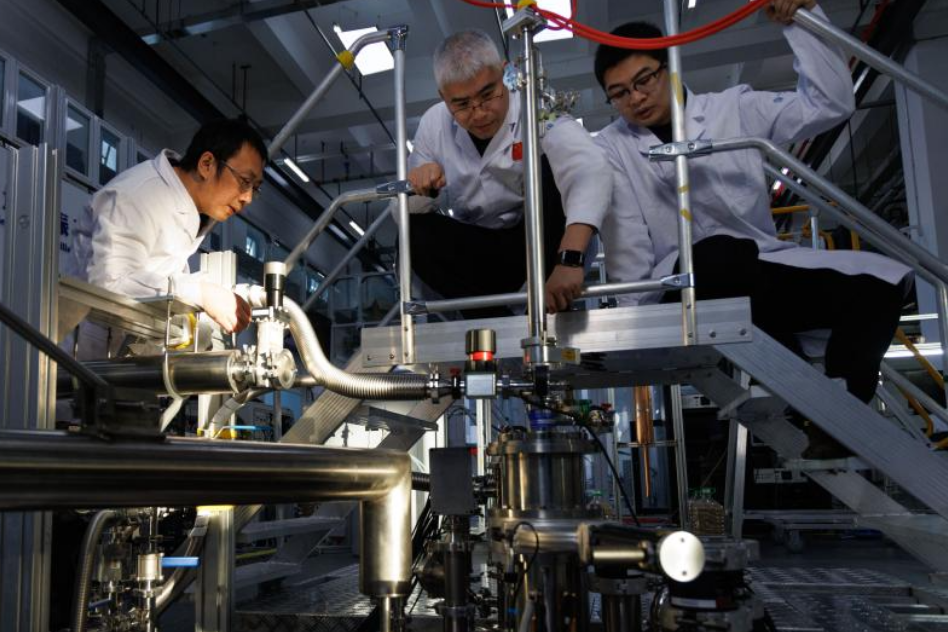
High magnetic fields serve as an extreme experimental condition for exploring scientific frontiers and play an irreplaceable role in discovering new phenomena and fostering new technologies. Strong-field superconducting magnets are devices operating at extremely low temperatures, featuring zero electrical resistance, strong magnetic fields, high stability, and low energy consumption. They are core equipment underpinning major scientific facilities, high-end medical applications, national defense, and other critical sectors. A “user magnet” refers to a shared, experimental magnet open to external research teams.
“However, the development of high-field superconducting magnets involves multidisciplinary challenges and faces numerous engineering bottlenecks, requiring extremely high standards for magnetic field strength, stability, and uniformity,” said Wang Qiuliang, an academician at the CAS Institute of Electrical Engineering. “Simultaneously, the high-temperature superconducting materials needed for magnet manufacturing present issues like strong anisotropy and difficulties in controlling dimensional precision, all of which significantly increase the challenges in magnet design and fabrication.”
In this breakthrough effort, the CAS Institute of Electrical Engineering and the CAS Institute of Physics leveraged their respective expertise in a collaborative research. The team from the Institute of Electrical Engineering achieved key technological breakthroughs in magnet design and construction, while the team from the Institute of Physics overcame challenges related to precision measurement and system integration under extreme conditions. Their joint efforts ultimately led to a leap in the performance of the fully superconducting magnet.
Notably, this user magnet will provide crucial support for researchers exploring the laws of the microscopic world and advancing both fundamental research and high-end equipment manufacturing. “For instance, in materials science, strong magnetic fields can help reveal the properties of novel superconducting materials; in life sciences, they can provide more precise experimental conditions for protein structure analysis,” explained Luo Jianlin, a researcher at the CAS Institute of Physics.
Addressing public concerns about cost and accessibility, Luo Jianlin noted that due to their zero-resistance characteristic, the operational costs of fully superconducting magnets are far lower than those of traditional resistive magnets. Furthermore, the magnet features a usable bore diameter of 35 millimeters, sufficient to meet the needs of most experiments, such as nuclear magnetic resonance (NMR) and material specific heat measurements.
“Teams from the Institute of Electrical Engineering and the Institute of Physics will continue their collaboration, aiming for even higher magnetic field targets of 40 Tesla and beyond,” said Wang Qiuliang. “We are also committed to expanding the magnet bore size and reducing operational costs, ensuring this national key instrument can support broader research and applications, thereby continuously consolidating China’s leading position in the field of high magnetic field technology.”