
Many people have had the same experience: staying up late or feeling anxious quickly leads to itchy skin and worsening dermatitis. Is this merely a coincidence? A new study by Chinese scientists has provided the first scientific answer.
On March 20th Beijing time, a research team led by Dr. Liu Shenbin, a young principal investigator at the Institutes of Brain Science, National Key Laboratory of Brain Function and Brain Diseases, and Frontiers Science Center for Brain Science, Fudan University, published a paper in the journal Science.
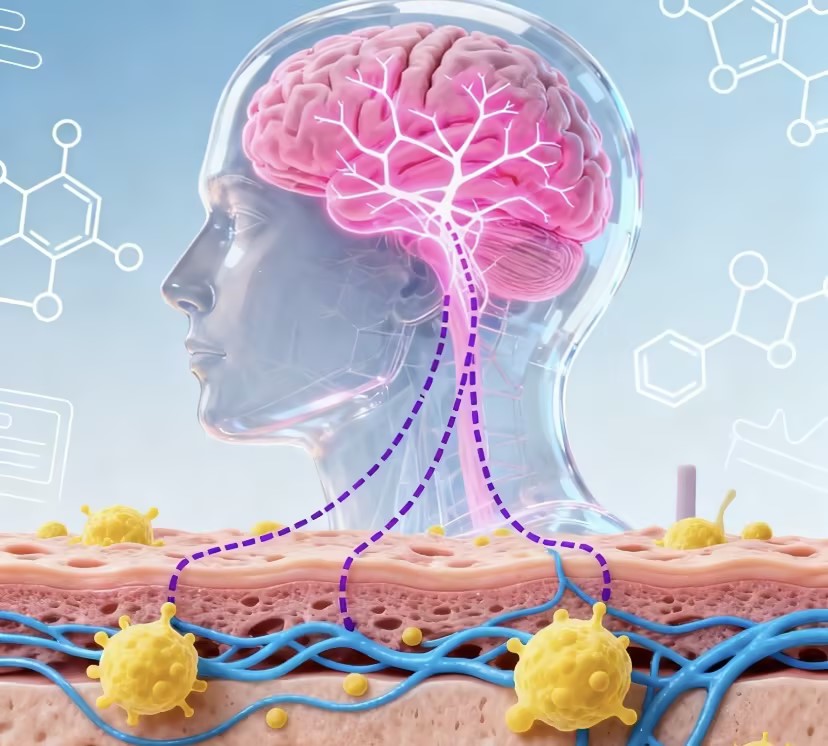
The paper is titled “A sympathetic nerve-eosinophil axis mediates psychological stress-induced exacerbation of skin inflammation”. The study systematically reveals a neuroimmune mechanism. Stress signals from the brain recruit and activate eosinophils through specific cutaneous sympathetic nerves, triggering a cascade of inflammatory amplification. For the first time, the research uncovers a hidden pathway connecting the brain and the skin. Psychological stress directly instructs immune cells to act via specific neural routes, thereby worsening skin inflammation.
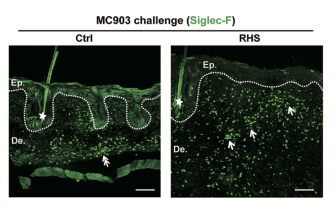
Starting with clinical patients, the team found that dermatitis patients who reported high stress levels had significantly elevated numbers of eosinophils – a type of immune cell – in their blood. Further animal experiments confirmed that under psychological stress, these cells flood into the dermal layer of the skin, becoming the main drivers of aggravated inflammation.
How do stress signals from the brain precisely reach the skin? The study shows that specific neurons in the peripheral sympathetic nervous system act as messengers. After receiving stress signals from the brain, these neurons release chemokines. Acting like a key, the chemokine binds to its receptor – a “lock” – on the surface of eosinophils. This recruits the cells into the skin and activates their inflammatory activity.
The entire process resembles the brain making a “phone call” to the skin, with the immune cells that cause itching and inflammation answering the call. This work not only maps the full signaling pathway of how psychological stress worsens dermatitis for the first time, but also offers a novel therapeutic strategy for atopic dermatitis, a condition affecting millions of people. In the future, blocking this pathway may help prevent skin damage caused by stress.