
Oryza sativa is one of the world’s most important annual food crops. Its ancestor, common Oryza rufipogon, however, is a perennial, creeping grass-like plant. How wild rice gradually evolved into annual cultivated rice during rice domestication has long remained an unsolved mystery.
On March 20th, 2026 Beijing time, a research team led by Academician Han Bin from the National Key Laboratory of Plant Trait Formation and Improvement, the Center for Excellence in Molecular Plant Sciences, Chinese Academy of Sciences, and a team led by Principal Investigator Wang Jiawei from the CAS Key Laboratory of Plant High-Efficiency Carbon Fixation, published a paper online as the cover story in the internationally prestigious academic journal Science. The paper is titled “Resetting of a tandem microRNA156 enables vegetative perennial growth in rice”. This study marks the first cloning of EBT1, a key gene that determines the perennial growth habit of wild rice. It also clarifies that changes in the expression pattern of this gene locus were critical for the shift from perennial to annual growth during rice domestication.
The research team first systematically investigated the phenotypes of 446 wild rice accessions. They found that some wild rice materials differed from annual cultivated rice. Instead of senescing and dying after seed maturation, these plants continuously sprouted new lateral branches from axillary buds at the nodes. These branches kept elongating and growing, then rooted and developed into new plants when touching the ground, showing a grass-like phenotype. In other words, developmental reversal occurred after flowering, returning to the vegetative growth stage – a phenomenon known as floral reversion – resulting in a clonal, perennial growth habit.
To identify the key gene controlling this perennial phenotype, the team conducted forward genetics using a chromosome segment substitution line population. The population was derived from a cross between the perennial Dongxiang wild rice W1943 Oryza rufipogon and the annual indica cultivated rice Guangluai 4 (GLA4). Using fine map-based cloning, the team finally mapped and cloned the gene, naming it Endless Branches and Tillers 1 (EBT1). This locus consists of two tandemly arranged microRNA genes: microRNA156B (MIR156B) and microRNA156C (MIR156C).
miR156 acts as a plant “age switch” that regulates plant development. According to the classic theory, miR156 is highly expressed in seedlings and gradually decreases with plant age, promoting the transition from vegetative to reproductive growth. Surprisingly, the team found that although MIR156B and MIR156C in wild rice also follow an age-dependent decline in expression, they are reactivated in axillary buds of tiller nodes after flowering. This reset of expression allows developmental reversal in axillary buds, restoring vegetative growth and continuously producing new tillers, thus forming a clonal growth pattern. Further analysis revealed that this unique reset is closely related to the epigenetic modification status of the wild rice EBT1 locus containing MIR156B and MIR156C.
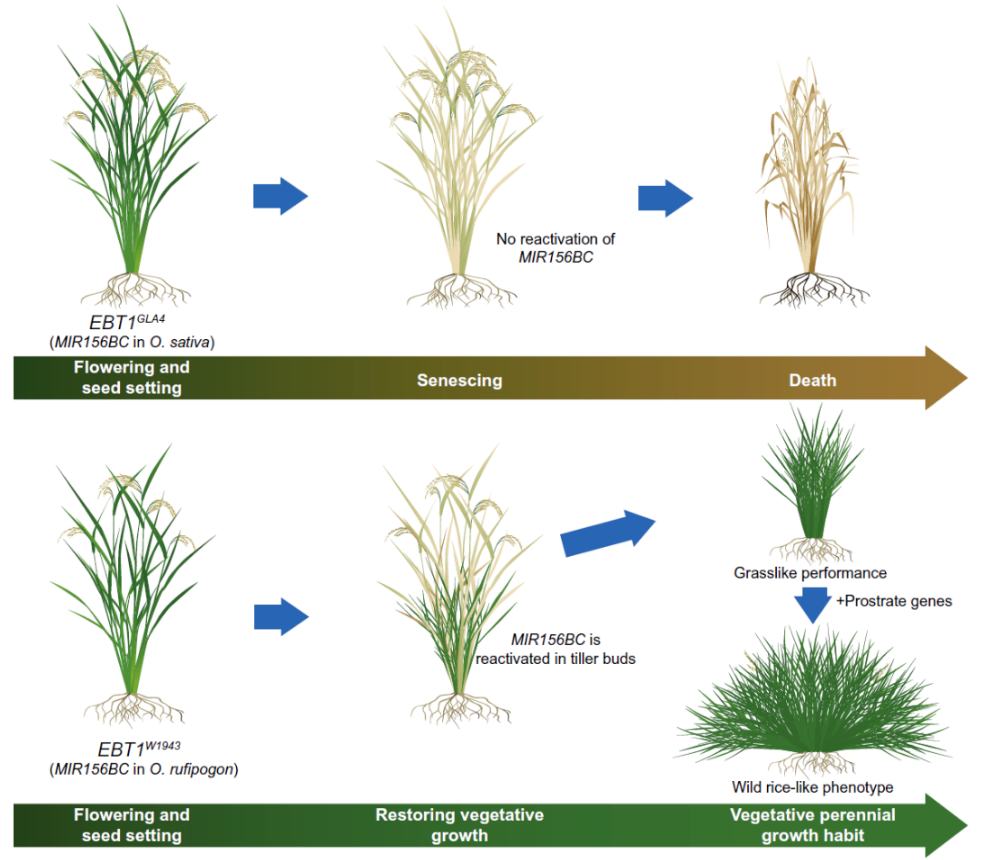
Population genomic and genetic variation analyses of this locus in wild and cultivated rice showed that this region underwent artificial selection during rice domestication. This suggests that in breeding high-yield, compact-architecture cultivated rice, humans may have inadvertently “lost” the perennial genes of wild rice. Furthermore, by pyramiding EBT1 with two known rice prostrate genes PROSTRATE GROWTH 1 (PROG1) and Tiller Inclined Growth 1 (TIG1), the team successfully created “wild rice-like” plants that recapitulate the grassy phenotype of wild rice. These pyramided lines show strong clonal reproduction ability and can survive for at least two years in field conditions in Hainan.
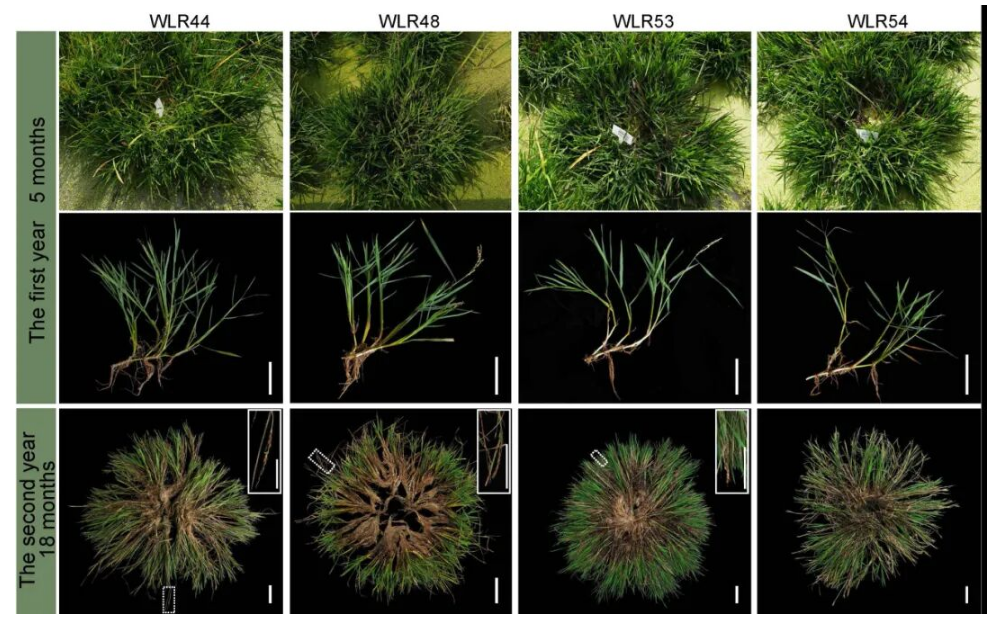
In summary, this study not only deepens our understanding of the evolution of plant life history strategies, but also provides important theoretical basis and genetic resources for the perennial improvement of rice varieties and the breeding of ratoon rice.
In an accompanying commentary written by Science reporter Erik Stokstad in the same issue: “Imagine a grain that grows back on its own every year, with no plowing or replanting. Farmers would save labor, and soil erosion would slow. Yet breeding such perennial grains – turning farm fields more into natural orchards – has proven difficult. Borrowing genes from wild rice might speed the process.”