
As temperatures rise, greenhouse strawberries, long the mainstream market staple, will soon go out of season and reappear only in autumn and winter. In Shanghai, multiple “cyber plant factories” are enabling people to enjoy strawberries all year round. Traditional greenhouse strawberry farming relies heavily on seasoned farmers’ experience. By contrast, plant factories adopt artificial intelligence (AI) algorithms to generate customized planting plans. Every strawberry plant receives tailored scientific care and maintains steady growth across four seasons.
What do AI-grown strawberries taste like? What new prospects will cyber plant factories bring to the future of China’s agriculture?
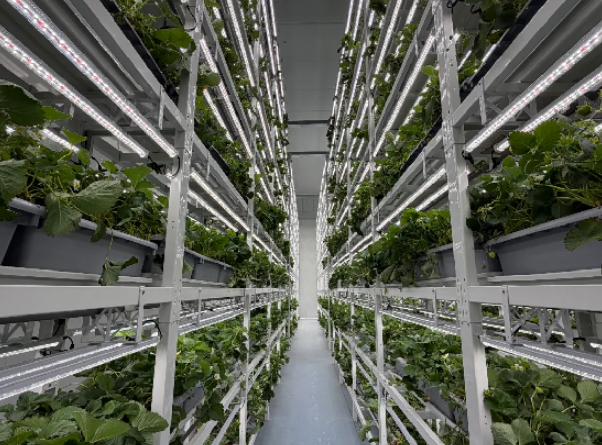
In an open area of Shanghai Agricultural Innovation Valley, four 50-square-meter container units hide innovative farming systems. Under fully artificial lighting, neatly arranged strawberry plants thrive, with some bearing bright red or pink ripe fruits. This is the final competition venue of the 5th Duoduo Agricultural Research Tech Competition. Four teams from universities, research institutes and agritech enterprises have built independent strawberry plant factories. Over the next six months, the teams will compete with their core AI technologies. They aim to achieve high yield, premium quality and low-energy cultivation of domestic strawberry varieties.
How exactly does AI grow strawberries?
The Berry Cube Team, led by Shanghai Jiao Tong University, has developed an intelligent image recognition diagnosis system. He Shiwei, team leader and a second-year postgraduate student at the School of Agriculture and Biology, Shanghai Jiao Tong University, cited uneven leaf discoloration as a common issue. This symptom can stem from various causes. Traditional troubleshooting requires repeated tests. Farmers have to rule out interfering factors one by one among humidity, temperature, water and fertilizer supply, a process that often takes a week or longer. The AI visual diagnosis and solution system is designed to identify strawberry diseases rapidly and deliver targeted solutions with higher efficiency.
He Shiwei explained that current agricultural production mainly depends on naked-eye observation for disease judgment. Existing agricultural diagnosis tools are mostly expert systems. Professionals analyze images and offer operational guidance. The team’s system focuses on precise diagnosis inside plant factories through data quantification. Hidden nutritional deficiencies are hard to spot from plant appearance alone. Leveraging convolutional neural network models, the AI tool conducts real-time image monitoring. The collected data supports continuous optimization of planting strategies and environmental regulation.
In practice, cameras capture the real-time growth status of strawberry plants. Deep learning systems analyze the images instantly. The system calculates the content of nitrogen, potassium and other elements in plants and generates targeted planting adjustment plans promptly. Lyu Zhaochen, a first-year postgraduate member of the team, added that subtle differences in leaf green shades visible to human eyes correspond to precise RGB color values in digital systems. RGB values range from 0 to 255. For example, a full red tone means an R value of 255 and zero G and B values. Human eyes can only distinguish vague color differences, while digital images provide accurate standards. The team judges leaf nitrogen content through color data to guide scientific fertilization.
Traditional farming follows the logic of relying on excessive fertilizer for high yields. AI-driven strawberry farming realizes precise nutrient supply by addressing plants’ actual needs. It effectively solves common pain points such as over-fertilization and delayed disease diagnosis for growers. From data analysis to field operation, the AI diagnosis system makes planting data-driven. It also automatically adjusts nutrient solution ratios and drip irrigation throughout the whole growth cycle.
After four months of data collection, the self-developed compact AI model of the Berry Cube Team has achieved a diagnosis accuracy of over 90%. Supported by AI algorithms, the team sets clear targets for the Yufeng strawberry variety: single-plant yield above 0.4 kilograms and stable sweetness of over 12 degrees. Chang Liying, supervising professor from the School of Agriculture and Biology, Shanghai Jiao Tong University, noted that the cyber plant factory explores in-depth integration of artificial intelligence and agricultural technologies.
Strawberries have a long growth cycle. The team collects environmental data, plant phenotypic images, leaf images and fruit images to train AI models continuously. The integrated intelligent system improves the accuracy of farm management decisions for specific planting scenarios and strawberry varieties. The next challenge lies in the hot July and August in Shanghai. The research team strives to optimize algorithms to guarantee stable strawberry production under high summer temperatures.
The competition for higher yield and better taste continues in the cyber plant factory at Shanghai Agricultural Innovation Valley. More than 60 kilometers away, a 3,456-square-meter smart strawberry plant factory in Baihe Town, Qingpu District, has officially started operation. The first batch of fresh strawberries will hit the market in mid-to-late May, and round-the-clock supply will be fully available starting from June. For the first time, these AI-grown smart strawberries will be served to ordinary consumers.
Fang Jianping, associate researcher at the Forestry and Fruit Research Institute of Shanghai Academy of Agricultural Sciences, told China National Radio that unmanned inspection robots have been deployed in experimental strawberry plant factories. The robots collect multi-dimensional plant data to build intelligent models for fruit ripeness identification, plant growth morphology and environmental response. These sub-models serve as core technical support for large-scale production in commercial smart strawberry plant factories.