
Elon Musk, CEO of Tesla, announced via X and official channels that the company’s first purpose-built autonomous taxi (Robotaxi), the Cybercab, has commenced large-scale production at its Gigafactory in Austin, Texas. This milestone marks the global automotive industry’s official entry into a new era of fully autonomous commercial mobility – featuring “steering-wheel-free, pedal-free” design – while representing a critical step in Tesla’s transition from an electric vehicle manufacturer to an autonomous mobility service provider.
From concept to mass production: On-track timeline
First unveiled at Tesla’s “We, Robot” event in October 2024, the Cybercab is designed exclusively for ride-sharing. A pre-production verification vehicle rolled off the assembly line two months ahead of schedule in February 2026, laying the groundwork for April’s mass production kickoff. Musk acknowledged that initial output will be “very gradual” due to constraints from the all-new supply chain, but the shift to continuous production signals the end of the testing phase.
Revolutionary design: Redefining vehicle form
As the world’s first native L4 autonomous production vehicle, the Cybercab abandons traditional driving paradigms with its “three-zero” core configuration: no steering wheel, no accelerator/brake pedals, and no conventional side mirrors. Engineered entirely without human driving capabilities, it offers no manual override options.
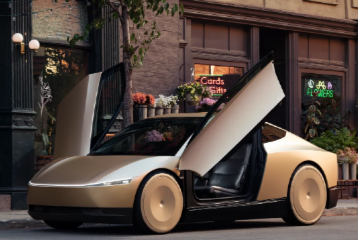
Cabin layout: A two-door, two-seat design prioritizes passenger experience, with only two comfortable seats and a central touchscreen – eliminating the traditional driver’s seat to let riders focus on work, rest, or entertainment.
Exterior & materials: The champagne gold stainless steel body (no paint required) balances durability and futurism, ideal for high-frequency ride-sharing. Gull-wing doors maximize accessibility in tight parking spaces, while the sleek fastback profile and enclosed wheel hubs minimize drag for enhanced range efficiency.
Charging & operations: Wireless inductive charging replaces external ports, paired with automated robotic cleaning – enabling end-to-end autonomous operations that reduce labor and time costs for ride-sharing services.
Core technology: Vision-based FSD & regulatory breakthroughs
The Cybercab’s autonomous capabilities rely entirely on Tesla’s full self-driving (FSD) system, powered by the vision-only Tesla Vision platform. Equipped with 8 high-definition cameras and the FSD V14 end-to-end neural network, it leverages AI for environmental perception, decision-making, and execution – eliminating the need for lidar or additional sensors.
A key regulatory milestone sets the Cybercab apart: unlike competitors like Waymo and Cruise, which require NHTSA exemptions (capped at 2,500 vehicles annually), the Cybercab meets all U.S. federal motor vehicle safety standards out of the box. This self-certification capability removes production limits, as confirmed by Lars Moravy, Tesla’s Vice President of Vehicle Engineering, clearing the path for global scalability.
Commercial outlook: Low-cost mobility to disrupt ride-sharing
Priced at under 30,000 (approximately RMB 210,000) far below traditional ride−sharing vehicles and autonomous test fleets – the Cybercab is poised to revolutionize pricing. Tesla projects a ride cost of just 0.20 per mile (around RMB 0.89 per kilometer), significantly undercutting current human-driven ride-hailing services.
Under the plan, the Cybercab will gradually replace Tesla’s existing Model Y ride-sharing fleet to become the backbone of its global Robotaxi network. Musk emphasizes that the Cybercab will eventually account for Tesla’s highest production volume, shifting the company’s revenue structure from “vehicle sales” to “mobility services” and unlocking a trillion-dollar ride-sharing market.
Industry impact: Accelerating autonomous mobility competition
The Cybercab’s mass production propels the global autonomous driving industry into a new phase of commercialization. The market currently splits into two camps: companies like Waymo using lidar-based multi-sensor systems for direct L4 deployment, and Tesla’s vision-based approach, iterating from L2 to L4 while unifying software across consumer vehicles and Robotaxis. The Cybercab’s launch validates Tesla’s technical route, intensifying competition between the two paradigms.
Industry analysts note that the Cybercab’s significance extends beyond a new vehicle launch – it represents the first large-scale production of a “driverless control” car in transportation history. It is expected to drive governments worldwide to accelerate autonomous driving regulation, foster broader adoption of the technology, and ultimately reshape urban transportation ecosystems by reducing traffic accidents and improving mobility efficiency.