
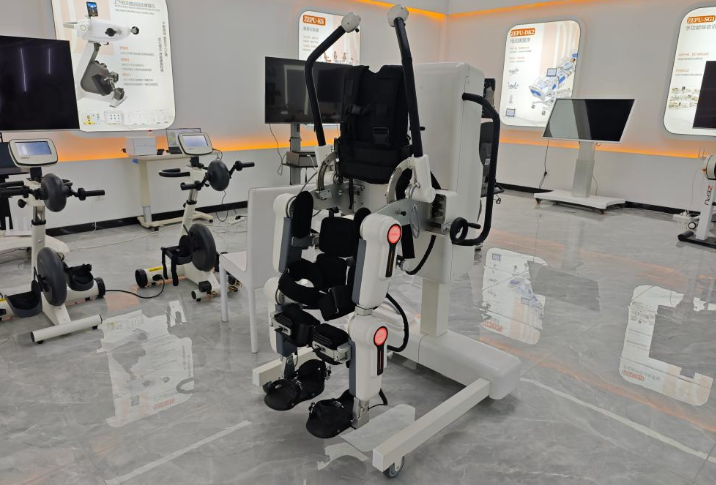
In the rehabilitation ward of a hospital in Qingdao, Shandong Province, sunlight filters through glass windows and falls gently on the training area. A patient with lower‑limb motor dysfunction caused by spinal cord injury undergoes gait training with an exoskeleton rehabilitation robot. His legs are fixed to the mechanical exoskeleton legs. Guided by the robot’s programmed movements, he walks with natural postures.
“This device delivers precise power assistance and gait correction, helping him rebuild motor nerve pathways,” said a rehabilitation therapist nearby. The exoskeleton rehabilitation robot is developed by Kangdao (Qingdao) Medical Technology Co., Ltd. In the company’s R&D laboratory, engineers wear sensors that monitor brainwave activity. They test the next-generation prototype robot based on brain-computer interface (BCI) technology.
Wu Changlin, General Manager of Kangdao, pointed at the jumping brainwave signals on the screen. “In the future, patients can control their left or right leg with their thoughts. They will enjoy more independent and personalized rehabilitation training, shortening recovery periods further.” This is no science fiction. It is a vivid example of China’s ongoing wave of technology-assisted disability support. Engineers speed up R&D and application of frontier technologies such as artificial intelligence, robotics and brain‑computer interfaces in disability support. From rehabilitation training to barrier‑free daily life, these technologies create new ways to improve life quality for people with disabilities. Against this rapid technological progress lies a practical challenge. Official data shows around 17 million visually impaired people live in China, yet only about 400 guide dogs are available. Traditional guide dogs require long training cycles and high costs. Most visually impaired people cannot rely on them to go out independently.
Smart guide dogs bring new hope to solve this problem
At the test site of Saifeite Engineering Technology Group Co., Ltd., Product Manager Han Shimin closes his eyes and holds a sensory guiding cane connected to a smart guide dog. The robot leads him steadily past obstacles. Han Shimin said affordable smart guide dogs will become “second eyes” for visually impaired people, supporting their barrier-free travel. So far, the smart guide dog by Saifeite has passed internal scenario tests. Larger-scale field trials will soon start in Qingdao.
People with limb disabilities also strongly demand affordable inclusive assistive products
In the rehabilitation room of Qingdao Liankang Prosthetics and Orthotics Co., Ltd., 59-year-old Sun Renchun and several other leg amputees practice walking with bionic legs fitted with intelligent knee joints. Wang Xu, a prosthetics technician, explained that these smart bionic legs are developed by BrainCo Inc. Compared with traditional mechanical prostheses that only support basic walking, the bionic legs adjust knee joints in real time via smart algorithms. They provide walking support more consistent with human physiology.
“I thought I would never stand again,” Sun Renchun said. “Surprisingly, I can walk steadily in just over half a month with these bionic legs.”
To date, more than 300 people with leg disabilities like Sun Renchun walk flexibly again with the help of bionic prostheses.
Beyond tangible assistive devices, subtle, invisible services are shifting from “people seeking services” to “services reaching people”. At Hengyunshan Station of Qingdao Metro Line 6, a wheelchair-using passenger is greeted by metro staff before reaching the station hall. Such thoughtful services are backed by smart station technologies.
“Our AI video analysis and intelligent response system acts as eyes and brains for the metro,” said Wang Yihua, Senior Engineer of Qingdao Metro, pointing at the monitoring screen. “It identifies assistive tools such as wheelchairs and white canes. It also analyzes passenger behaviors to judge whether help is needed.”
Dong Yanjun, Deputy Station Chief of Hengyunshan Station Area, said staff once relied on visual checks and patrols to find passengers in need. The method was inefficient and prone to omissions. “Now the system sends real-time alerts. We can offer timely and efficient support for special-need passengers.” Since its pilot launch on Line 6, the system has served over 10,000 passengers.
Earlier, nine government departments including the China Disabled Persons’ Federation (CDPF) jointly issued the Guidelines on Promoting Technology-Assisted Disability Support. They regard R&D of disability-support technologies as a strategic pillar for high‑quality development of undertakings for people with disabilities.
“As one of the key pilot regions for technology-assisted disability support, Qingdao builds an innovation platform for cross-sector cooperation,” said Song Zongtao, Deputy Chairman of the Qingdao Disabled Persons’ Federation. “We set up a full-chain service system covering demand collection, research breakthroughs, pilot verification, scenario application and inclusive promotion.” “In the future, we aim to develop replicable models to let more people with disabilities benefit from technology-assisted support.”