
The Center for Software and Integrated Circuit Promotion under the Ministry of Industry and Information Technology of China has released the Research Report on the Development of Smart Elderly Care Robots (2026 Edition). The report shows that China’s elderly care robot industry has taken initial shape and its market size maintains robust growth. It is projected that the market scale will exceed 10 billion yuan this year.
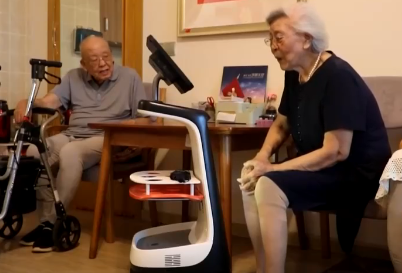
Rapid market expansion is mainly driven by accelerating population aging and the growing imbalance between elderly care supply and demand. In 2025, China’s population aged 60 and above reached 323.38 million. More than 130.00 million elderly people live alone or in empty-nest families. China spent only about 21 years transitioning from an aging society to a deeply aging society, far faster than the average pace among developed economies.
Liu Wenqiang, Vice President of the China Electronics Information Industry Development Research Institute, shared his views. The aging population keeps expanding, while professional caregivers remain in long-term shortage. Elderly people have an increasingly urgent demand for smart technologies and devices. As an innovative solution to traditional elderly care challenges, smart elderly care robots boast broad market prospects.
After years of development, a complete industrial chain has formed in this sector. It covers core component research and development, complete machine manufacturing, system integration and operational services. Major breakthroughs have been achieved in key human-machine interaction technologies, including multimodal perception, artificial intelligence algorithms and high-precision motion control. Domestic products have reached world-class levels in core functions such as fall detection, remote monitoring and rehabilitation training.
Product functions have also been greatly enriched. Early robots mainly handled simple tasks like cleaning and food delivery. Now they serve five major categories, including daily care, health monitoring, emotional companionship, patient transfer and rehabilitation support. They can cater to diverse needs of seniors with different health conditions.
Liu Wenqiang added that the industry needs to advance in technology, application scenarios, standards and safety to improve product quality. New technologies such as large AI models, advanced new materials and safe interactive systems should be integrated into robots. Products also need upgrades targeting the actual demands of the elderly.
In terms of application scenarios, elderly care institutions remain the largest market, accounting for around 50% of total usage. Community-based elderly care takes up 30%, and home-based care accounts for 20%. Notably, the home care segment sees the fastest growth. By product type, care robots register an average annual growth rate of about 32%, while companion robots grow at roughly 42%. The industry has formed a development pattern where institutional use dominates, community application follows and home use expands rapidly.
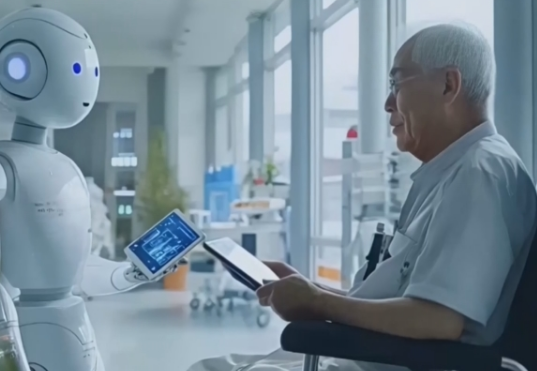
China faces a shortage of over 5 million professional elderly care workers amid rising care demands. A qualified elderly care robot requires not only solid technical performance, but also a full understanding of seniors’ physical and mental needs. Only in this way can the elderly use the devices with peace of mind and comfort.
Cheng Chen, Operation Manager of an exoskeleton robot enterprise, explained the value of robotic exoskeletons. Such equipment does not simply drive users to move. Instead, it guides users to form correct walking gaits through active coordination. It helps seniors tackle walking difficulties including limited mobility, unsteady steps and short walking distances at different physical stages.
For bedridden seniors, toileting and in-bed bathing are strenuous care work that requires great patience. Smart toileting robots and portable bathing machines have greatly improved these tough, awkward and high-risk care procedures. They make the work safer, more dignified and less labor-intensive.
Zhou Yang, Vice Dean of the School of Nursing at Yueyang Vocational and Technical College, introduced their self-developed brain-computer AI toileting robot. Equipped with a head-mounted device, seniors can finish all care operations simply by turning their heads or blinking eyes without any assistance.
Physical care is essential, and so are health management and emotional needs. The report indicates that health monitoring, safety protection and social companion robots are the fastest-growing product categories. Even as robot functions become more diverse, a gap still exists between technical design and real demands.
Li Mengwei, General Manager of the Robot and Intelligent Equipment Research and Evaluation Department at the Center for Software and Integrated Circuit Promotion, pointed out current problems. Existing robots show deficiencies in intention recognition, complex behavior understanding and compliant control. Their performance cannot fully match the unstructured, highly interactive and high-safety requirements of real elderly care scenarios. In the future, industrial competition will shift from technical display to in-depth scenario adaptation and reliable engineering capabilities.
Despite the booming market valued at nearly 10 billion yuan, home adoption of elderly care robots still faces hurdles. The industry needs to overcome three core challenges: cost, safety and unified standards.
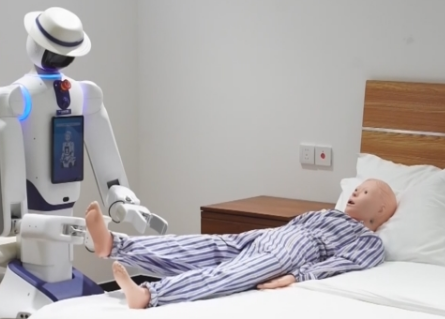
Most fully functional care robots are priced at hundreds of thousands of yuan, unaffordable for ordinary families. Localization of core components and large-scale production are needed to cut costs. Besides, robots serve vulnerable elderly groups. Clear rules must be set to guarantee electrical safety, operational stability and personal data privacy.
Currently, the industry is in the early stage of shifting from technology-driven development to application-driven growth. It still has prominent bottlenecks in adapting to complex scenarios, maintaining long-term system stability, controlling costs and achieving large-scale promotion.
Some products focus too much on functional demonstrations rather than user experience. They prioritize single technology over systematic integration, resulting in low long-term usage rates. In addition, the lack of unified industrial standards has led to data silos between devices of different brands, blocking the development of connected smart elderly care ecosystems.
To break the barriers of large-scale application, Li Mengwei put forward suggestions. Technically, single-point intelligence needs to evolve into more reliable systematic intelligence. In terms of business models, combined solutions integrating devices, insurance and services can lower access thresholds. The industry should also accelerate the formulation of unified standards for interconnection and safety certification, so as to build an open and collaborative industrial ecosystem.