
May 26th saw the LVK Collaboration, a joint team of the U.S. Laser Interferometer Gravitational-Wave Observatory (LIGO), Italy’s Virgo Gravitational Wave Detector and Japan’s Kamioka Gravitational Wave Detector (KAGRA), release the fifth edition of their Gravitational-Wave Transient Catalog, known as GWTC-5, online.
The catalog records 161 new gravitational wave signals generated by black hole mergers, captured by LVK between April 10th, 2024 and late January 2025. With these new entries, the total number of detected gravitational wave signals from space has risen to 390. Relevant research papers have been submitted to The Astrophysical Journal and The Astrophysical Journal Letters respectively.
The signal dataset compiled in GWTC-5 acts like a crystal-clear cosmic treasure map. It has led scientists to uncover a string of valuable cosmic discoveries. These include the most precisely located gravitational wave source ever recorded, the sharpest gravitational wave signal detected to date, and evidence pointing to the existence of second-generation black holes.
Dr. Daniel Williams, researcher at the Institute for Gravitational Research, University of Glasgow and a member of the LVK Collaboration, said the new batch of signals broadens and deepens humanity’s understanding of the universe once again.
Leo Zicada from the University of Nevada, Las Vegas added that the fast-growing library of gravitational wave signals is pushing astronomy into a brand-new era. It allows scientists to test the General Relativity theory with unprecedented precision.
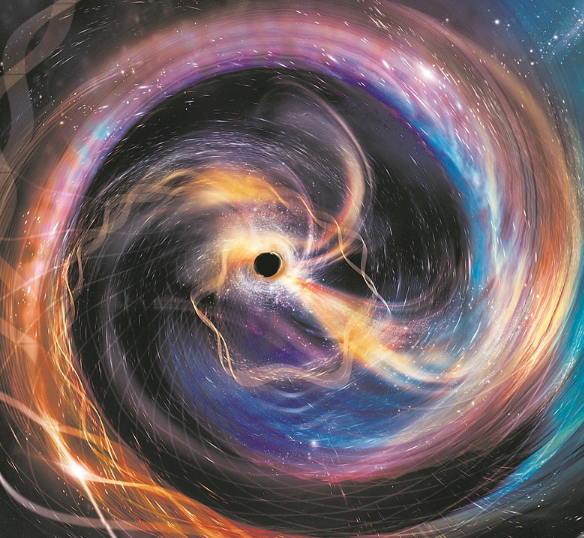
The most precisely pinpointed gravitational wave source
Phys.org reported the news on May 26th. On June 15th, 2024, two LIGO detectors and the Virgo detector jointly captured the signal GW240615. It set a new record for the most accurate sky localization of any gravitational wave event.
Thanks to simultaneous observations from the three detectors and triangulation technology, scientists narrowed down the source of this gravitational wave to a tiny sky patch covering just six square degrees. Roughly three billion light-years away from Earth within this region, a black hole 26 times the mass of the Sun crashed into another black hole 30 solar masses heavy. The ripples in spacetime created by this violent collision traveled billions of light-years across space before being picked up by detectors on Earth.
This major leap in positioning accuracy would not have been possible without Virgo’s return to operation. Starting in April 2024, Virgo rejoined the global observation network. It greatly boosted the positioning power of the multi-messenger astronomical array and drastically improved localization precision. With this upgrade, researchers can match each black hole merger to its host galaxy far more easily.
Accurate positioning brings far more than a single world record. Alex Papadopoulos, a researcher at the University of Glasgow’s Institute for Gravitational Research, explained that the expanding gravitational wave signal sample pool helps answer one of the most critical questions in cosmology: how fast is the universe expanding?
The expansion rate of the universe is described by the Hubble constant. Gravitational waves let scientists calculate this constant by estimating the distance to black hole merger events.
Xinyu Chen, a researcher from the University of Texas at Austin, offered further explanation. The Hubble constant reveals both the expansion speed and age of the universe. However, different measurement methods have produced conflicting results so far. This inconsistency is widely known as the Hubble Tension.
If this discrepancy persists, it may mean the current standard model of cosmology is incomplete. Using the new gravitational wave sources from GWTC-5, the research team obtained a Hubble constant value with around 25 percent higher precision than previous measurements. This significant improvement gives scientists greater confidence to solve one of the biggest puzzles in modern cosmology.
The clearest “cosmic whisper”
EurekAlert!, a news platform run by the American Association for the Advancement of Science (AAAS), published a related report on May 26th. Capturing gravitational waves means fighting against constant background noise. Signal clarity is measured with the Signal-to-Noise Ratio (SNR).
GWTC-5 contains the sharpest recorded cosmic whisper to date: the signal GW250114, which boasts an SNR of 76.9.
This signal originated from two black holes, 32 and 34 times the Sun’s mass respectively. They merged deep in space around 1.3 billion light-years away, and the resulting gravitational waves reached Earth on January 14th, 2025.
Dr. Keefe Mitman, a physicist at Cornell University, commented that GW250114 delivers the strongest and clearest signals ever extracted from binary black hole mergers. It works like a custom measuring stick to test General Relativity. Every tiny detail of the signal aligns perfectly with Albert Einstein’s theoretical predictions.
Beyond this milestone, Dr. John Veitch from the University of Glasgow shared another key finding. Using this ultra-clear signal, the LVK Collaboration verified Stephen Hawking’s 1971 Black Hole Area Theorem with a confidence level as high as 99.999 percent.
The theorem states that the total area of the event horizons of two merging black holes can never shrink after collision. An event horizon is the boundary beyond which no light can escape a black hole’s gravity.
Calculations based on GW250114 yielded striking figures. Before the merger, the combined event horizon area of the two black holes stood at roughly 240,000 square kilometers. After the collision, the newly formed black hole’s event horizon stretched to nearly 400,000 square kilometers. Once again, the cosmos followed theoretical predictions with perfect precision.
Second-generation black holes reveal their traces
The most eye-catching discovery within GWTC-5 is the potential existence of second-generation black holes. These objects show up in two gravitational wave events: GW241011 and GW241110. The two events took place around 700 million light-years and 2.4 billion light-years from Earth respectively.
Clues from the merging black holes’ spin directions, rotation speeds and masses hint at their unique origin. They most likely did not form from the gravitational collapse of single massive stars. Instead, they grew from the merger of older black holes.
Second-generation black holes tend to form in extremely dense cosmic environments. Such locations include dense star clusters or the cores of galaxies. In these crowded regions, black holes collide repeatedly and merge step by step to form these rare composite objects.
These second-generation black holes weigh between 10 and 20 times the mass of the Sun, and spin at extremely fast speeds. Their existence directly challenges mainstream theories about black hole formation and evolution. It suggests numerous complicated astrophysical formation pathways are yet to be fully mapped out by researchers.
Dr. Carl-Johan Haster, assistant professor of astrophysics at the University of Nevada, Las Vegas, reflected on the value of new gravitational wave detections. Every newly spotted gravitational wave signal expands human knowledge of the universe. Black hole merger events act both as windows into astrophysics and invaluable space laboratories for testing fundamental physical laws.
GWTC-5 is more than a continuously expanding catalog of gravitational wave signals. It is a treasure trove packed with scientific data.
Jona Kanner, senior research scientist at the LIGO Laboratory, California Institute of Technology, noted that the data from this catalog will fuel research for decades to come. It holds clues to unsolved questions across cosmology, stellar evolution and gravitational theory.
Ed Porter, researcher at the Laboratory of Astroparticle Physics and Cosmology, French National Centre for Scientific Research (CNRS), stressed that the release of GWTC-5 marks a major shift for gravitational wave astronomy. The field has moved past its early groundbreaking discoveries. It has matured into a precise science that can examine physical laws and cosmic history down to astonishing fine details. Countless hidden cosmic treasures remain waiting to be uncovered through gravitational wave research.