
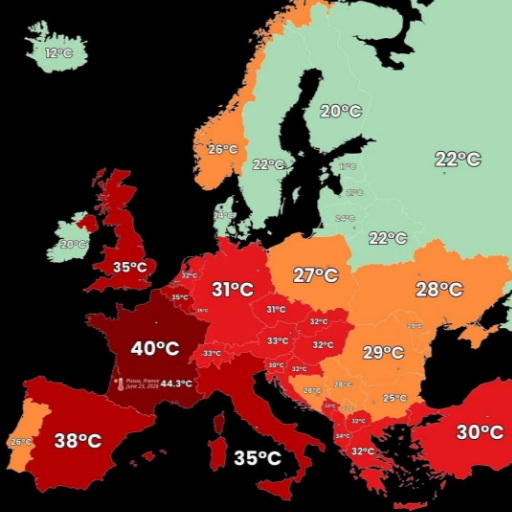
Sweeping extreme heatwaves have battered Europe this summer, with local temperatures surging above 45°C in France and Spain, and red heat warnings issued across Germany, Austria and Italy. Restrained by old architectural restrictions, sky-high electricity tariffs and extremely low air conditioner penetration, European consumers are facing an unprecedented cooling shortage. Against this backdrop, a full range of Chinese-made summer cooling products have become runaway bestsellers across the continent. Backed by a complete industrial chain, localized customized innovation and mature cross-border e-commerce channels, Chinese portable cooling appliances and daily cooling goods have seen export figures hit a record high, emerging as a standout growth driver for China’s foreign trade in the first half of 2026.
Soaring local demand creates huge market gap
Europe has long suffered a structural shortage in household cooling facilities due to its historically mild climate. The overall household air conditioner penetration rate in the EU is less than 20.0%, merely 3.0% in Germany and 5.0% in the UK. Most historic buildings in European cities ban external wall drilling for air conditioner installation, and professional installation fees often exceed 1,000 euros, far higher than the cost of the equipment itself. In addition, residential electricity prices have climbed to 0.4 euros per kilowatt-hour, making traditional air conditioning unaffordable for most families amid soaring living costs.
The unmet demand has triggered a frantic shopping boom. Domestic portable air conditioners and electric fans are frequently out of stock in supermarkets across France, Germany and Austria. Second-hand platforms have seen the price of Chinese portable air conditioners skyrocket from 700-800 euros to 1,500-5,000 euros, with robust transactions continuing. Short-video platform TikTok has witnessed over 100 million views on the hashtag #ChinaCooling, with neck fans, semiconductor handheld coolers and ice silk mats becoming viral summer must-haves among European consumers, driving a 288.0% month-on-month surge in sales of soft cooling home textiles.
Customs data shows explosive export growth
Official customs statistics confirm the booming export momentum. In the first six months of 2026, China’s total export value of air conditioners to the EU reached 3.76 billion US dollars, a year-on-year increase of 43.2%, hitting a new historic high for the January-June period. Exports of installation-free portable air conditioners to Western Europe jumped more than 70.0% year on year, with France, the Netherlands and Belgium doubling their imports of Chinese air conditioning products.
Cooling small home appliances and daily commodities have also achieved explosive growth. In the first five months of the year, China’s electric fan exports to Portugal surged 96.5% year on year, while exports to the UK, Spain and Germany rose by more than 20.0%. Retail sales of electric fans in Italy soared 543.0% month on month. Exports of household ice makers from Ningbo manufacturing bases increased by 70.0% year on year, with bulk orders from European families and local cafes. Meanwhile, orders for ice silk cooling mats from Zhejiang and Jiangsu manufacturers rose 120.0% year on year, with over 80 containers of cooling goods shipped from Yiwu to Europe daily.
Made-in-China upgrades: From low-cost OEM to localized smart manufacturing
The booming sales mark a key shift for Chinese manufacturing, moving beyond low-end, low-cost original equipment manufacturing to targeted, scenario-based innovation tailored for European markets. Firstly, Chinese brands including Midea, Gree and TCL have launched drill-free portable air conditioners that require no fixed installation. Featuring movable casters and easy self-assembly, the products perfectly adapt to European old building regulations and rental living habits, while meeting Europe’s highest A+++ energy efficiency standards.
Secondly, Chinese cooling products cover diversified consumer demands. High-end portable air conditioners meet whole-house cooling needs, while affordable handheld coolers, solar cooling hats and spray umbrellas serve outdoor workers and pedestrians. Zero-power ice silk products fill the gap in the mid-range energy-saving cooling market. Thirdly, China’s full industrial chain enables rapid flexible production. Manufacturing clusters in Foshan, Ningbo and Yiwu have launched round-the-clock production to fulfill urgent orders, with shortened delivery cycles via China-Europe freight trains and cross-border e-commerce platforms.
Climate-driven consumption opens long-term foreign trade track
Industry analysts point out that with extreme high temperatures becoming normalized in Europe, cooling products have evolved from seasonal optional goods to daily necessities. Following the popularity of Chinese electric heaters in Europe last winter, the hot-selling summer cooling gadgets have completed the full coverage of seasonal temperature-control consumer goods for Chinese exports.
Cross-border e-commerce has become a core booster of the export boom. Data shows that the GMV of cooling small appliances on Alibaba.com increased 77.0% year on year. Most European retailers have placed urgent extended orders scheduled for delivery until September, while Chinese manufacturers are already developing upgraded lightweight, low-energy cooling products for the 2027 summer season.
Outlook: Seize climate consumption opportunities to strengthen global competitiveness
Relevant surveys by Chinese customs and the Ministry of Commerce indicate that the overseas popularity of Chinese cooling products offers vital inspiration for foreign trade transformation. By leveraging complete industrial chain advantages and conducting differentiated innovations for overseas segmented scenarios, Chinese enterprises can break free from homogeneous price competition. Tapping climate-driven consumer demand has created sustainable new growth tracks for China’s home appliance and small commodity industries.
As global extreme weather events intensify, temperature-control consumer goods boast long-term market growth potential. In the future, Chinese manufacturers will further explore high-temperature markets in Europe and North America, optimize product performance and energy efficiency, and consolidate the global leading position of Made-in-China temperature-control products, continuously fueling steady growth in China’s foreign trade.