
On July 21st, the High Intensity Heavy-ion Accelerator Facility (HIAF), a national major science and infrastructure project located on Renping Peninsula in Huizhou, Guangdong Province, successfully passed technical acceptance organized by the Chinese Academy of Sciences. All core indicators have met or exceeded design standards, marking its official entry into trial operation and opening for global researchers. The completion of this major national research facility comes after 16 years of planning and seven years of construction. China now boasts a new-generation heavy-ion research platform at world-leading standards.
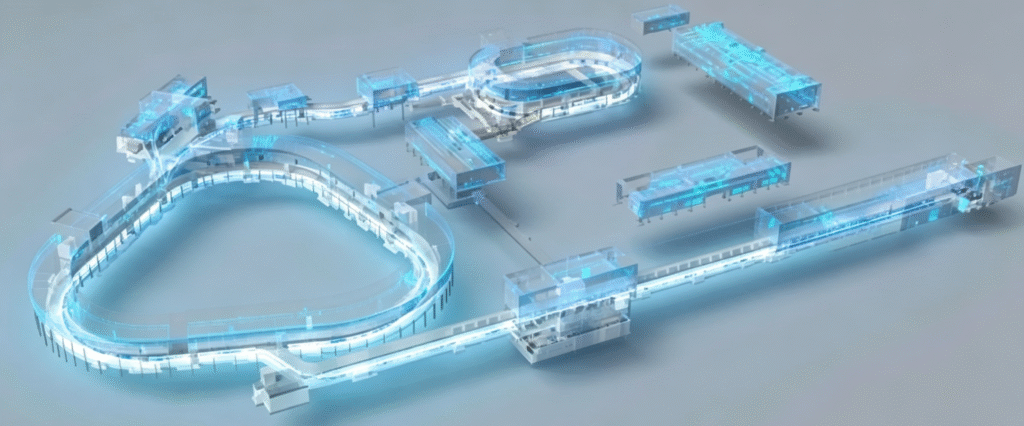
As a key project outlined in the Medium- and Long-term Plan for National Major Science and Technology Infrastructure Construction (2012-2030), HIAF was designed and built under the lead of the Institute of Modern Physics, Chinese Academy of Sciences. It is the world’s first composite heavy-ion research facility integrating a superconducting linear accelerator, synchrotron booster and high-precision storage ring. The total beam line of the facility stretches approximately 2 kilometres, equipped with more than 6,000 sets of core equipment, over 5 million components, and process pipelines exceeding one million metres in total length. Construction officially kicked off at the end of 2018, and the facility achieved its first successful beam extraction in October 2025, setting a world record for the rapid commissioning and full connection of similar large-scale accelerators.
Simply put, heavy ions are charged atomic nuclei stripped of extranuclear electrons. The term “high intensity” means the facility can generate extremely large quantities of ion beams in a single output. The accelerator can accelerate ions of nearly all elements ranging from hydrogen to uranium, propelling particles to up to 96.4% of the speed of light, artificially recreating extreme cosmic environments such as stellar explosions and neutron star mergers inside the laboratory. During pre-acceptance testing, the facility successively set new world records for pulsed beam intensities of oxygen ions and bismuth ions, representing respective improvements of three times and 7.5 times compared with previous global benchmarks. Experimental nuclear physics data that once took research teams worldwide years to collect can now be acquired within hours using HIAF, bringing a leap forward in research efficiency.
“Mankind has yet to fully uncover the origins of heavy elements such as gold and silver in the universe, nor determine the stability boundaries of atomic nuclei,” said Yang Jiancheng, Chief Engineer of HIAF. Supported by high-intensity heavy-ion beams, scientists will carry out a series of cutting-edge fundamental studies: Exploring the mass limits for the existence of atomic nuclei, precisely measuring the masses of thousands of unstable nuclei, and clarifying key astrophysical processes responsible for the synthesis of heavy elements in the cosmos, addressing long-standing fundamental physics puzzles.
Beyond fundamental research, the facility promises broad prospects for interdisciplinary applications. In healthcare, it can produce new medical radioisotopes to supply materials for targeted tumour drugs and precise heavy-ion radiotherapy, advancing treatments for hard-to-cure cancers. For aerospace engineering, high-energy ions can simulate space radiation environments to test radiation resistance in satellite chips and spacecraft components, safeguarding deep-space missions. In nuclear energy research, it supports irradiation ageing experiments on nuclear materials to develop materials for next-generation advanced reactors. The facility also facilitates radiation breeding and the creation of novel functional materials.
During construction, the team overcame multiple bottleneck technologies. Key equipment including magnetic alloy radio-frequency cavities, ultra-high vacuum systems and high-precision beam control systems had long been monopolised by overseas suppliers with strict technical barriers. After years of independent research, scientists delivered a fully domestically controllable technical system for heavy-ion accelerators, covering all core hardware and beam manipulation software. The team pioneered a digital twin construction model, cutting the installation cycle from the 2-3 years typical of comparable international facilities down to eight months, forming a replicable Chinese solution for building major scientific infrastructure.
The expert acceptance panel concluded that all five experimental terminals meet world-class performance standards. Multiple subdivided indicators lead the globe, including the precision of nuclear mass measurement via the high-precision circular spectrometer and the detection limit of the low-energy nuclear structure spectrometer. During trial operation, research teams from home and abroad will launch the first formal experiments successively, focusing on nuclear astrophysics, radioactive nuclides, atomic and molecular physics, material irradiation and joint interdisciplinary investigations.
Industry experts noted that HIAF fills the gap of large nuclear science infrastructure in southern China within the Guangdong-Hong Kong-Macao Greater Bay Area. Together with the Heavy Ion Research Facility in Lanzhou, it forms a coordinated north-south layout and builds a complete innovation chain for heavy-ion science research. The facility will attract top scholars specialising in nuclear physics, astrophysics and medical physics from around the world, continuously generating original landmark scientific achievements. It will also drive high-end industrial development in upstream and downstream sectors including accelerator technology, superconductivity and precision detection.
Moving forward, researchers will continuously optimise beam stability and improve supporting conditions for experimental terminals. Regular scientific experiments are scheduled to commence at the end of 2026, with beam time applications open to global users to build a globally influential centre for heavy-ion science.