
Local industrial technological innovation has reached a new milestone with the official release of the upgraded 3.0 Pro intelligent chemical industry artificial intelligence (AI) model, marking the first specialized industrial large model in China’s chemical sector capable of shifting from passive knowledge question and answer (Q&A) to active intelligent execution. The breakthrough empowers the province’s traditional chemical and new material industries with intelligent, efficient, and safe digital transformation solutions.
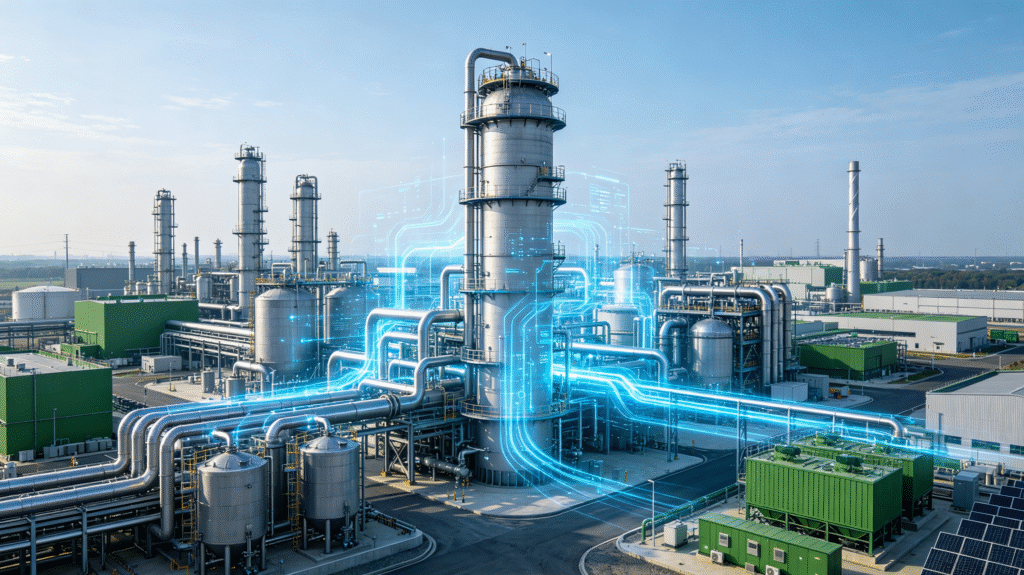
Different from conventional general artificial intelligence models that focus on universal dialogue and basic data analysis, the newly upgraded chemical industry AI model is deeply customized for the full industrial chain of fine chemicals, new chemical materials, and green chemical production. Built on massive professional chemical industry databases, process parameters, safety operation specifications and environmental protection standards, it achieves accurate perception, independent judgment and automatic execution of complex industrial tasks.
The 3.0 Pro version has achieved core upgrades in practical industrial capabilities. It can independently complete whole-process intelligent work including production parameter optimization, chemical reaction simulation, product formula iteration, safety risk pre-warning, and energy consumption intelligent regulation. In actual factory test scenarios, the model effectively reduces manual intervention in complex chemical production links, stabilizes product quality consistency, and cuts comprehensive production energy consumption by a significant margin.

As a key provincial digital empowerment project for traditional pillar industries, the intelligent chemical AI model has completed adaptive docking with local chemical industrial parks and key leading enterprises. It covers multiple core scenarios such as intelligent production scheduling, real-time environmental monitoring, equipment fault diagnosis, and intelligent supply chain management. The localized application breaks the long-term dilemma of insufficient industry-specific AI solutions for traditional chemical manufacturing.
Tech and industrial insiders noted that general AI models often lack professional industry logic and cannot adapt to the high-precision, high-safety and high-complexity requirements of chemical production. The province’s customized chemical industry large model fills the gap of vertical intelligent application in the domestic chemical sector. It provides a replicable and promotable digital transformation template for traditional process manufacturing industries across the country.
To further scale up intelligent industrial applications, the provincial science and technology and industrial authorities will launch a special promotion plan for the chemical AI model. The government will support more small and medium-sized chemical enterprises to access the intelligent system, carry out targeted technical transformation, and build a number of benchmark intelligent chemical factories. Meanwhile, local universities and research institutions will jointly optimize the model’s algorithm accuracy and scenario adaptation capability.
Moving forward, the province will continue to deepen the integration of artificial intelligence and real economy. Relying on the leading advantages of the new chemical material industry, it will continuously expand the application boundary of vertical industrial large models, accelerate the green, intelligent and high-end transformation of traditional industries, and cultivate new growth drivers for regional high-quality industrial development.