
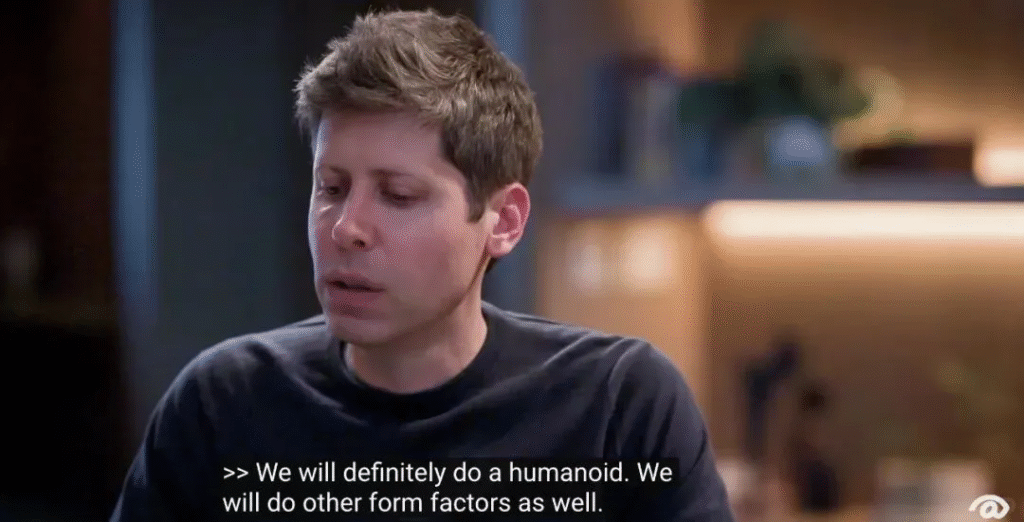
OpenAI has officially confirmed its entry into the humanoid robotics market, with Chief Executive Officer (CEO) Sam Altman revealing for the first time that the company will develop its own humanoid robots. The announcement came during Altman’s appearance on the Sources podcast on September 2nd, 2026, where he stated unequivocally: “We will definitely do a humanoid. We will do other form factors as well”. This marks a significant strategic pivot for the artificial intelligence (AI) company, which had previously focused on providing AI models to robotics partners rather than building hardware itself. While Altman acknowledged that humanoid robots are not an immediate priority, he expressed strong long-term optimism, stating that “everyone should have a personal robot”.
Altman justified the humanoid form factor by noting that the physical world is built for human bodies. “The world is very much designed for people,” he explained, citing everyday tasks such as opening doors, typing on computers, and cleaning kitchens. Rather than redesigning the environment, a humanoid shape allows robots to adapt to existing infrastructure. However, Altman stressed that the robot’s appearance is secondary to its intelligence: “The form factor is not the most important thing. What really matters is the brain that makes the robot work”. OpenAI is pursuing two parallel tracks: humanoid robots and specialized non-humanoid robots designed for data center applications, where human-like form may not offer practical advantages.
The robotics initiative builds on OpenAI’s earlier forays into physical AI, which were suspended around 2020 due to a scarcity of real-world training data. The company revived its robotics efforts on May 31st, 2026, with the formal establishment of the OpenAI Robotics division, led by Aditya Ramesh, who previously headed the Sora video generation project. The division grew out of an internal world-simulation research program that had been rebuilt since early 2025. OpenAI’s careers page currently lists 19 robotics-related positions in San Francisco, up from 11 when the division launched, with a focus on hardware actuators, printed circuit board (PCB) layout, firmware, and supply chain roles. This hiring spree signals OpenAI’s ambition to build an integrated system encompassing models, software, and hardware.
The announcement came just one day after OpenAI released GPT-6 Astra on September 3rd, 2026, which the company described as its most capable and aligned model to date. The model’s advanced reasoning and world-understanding capabilities are expected to serve as the foundational “brain” for OpenAI’s future robots. Altman clarified that near-term applications will focus on industrial infrastructure and manufacturing, particularly robots that assist skilled workers in building and operating data centers. Consumer-grade home robots remain a longer-term vision. OpenAI’s move into hardware puts it in direct competition with companies like Tesla and Figure AI, with which OpenAI previously partnered before the collaboration ended in early 2025. Global humanoid robot shipments reached approximately 19,100.00 units in the first half of 2026, up from 5,100.00 units a year earlier. OpenAI has not yet disclosed a launch date, production targets, or manufacturing partners.