South Korea’s state-run power utility Korea Electric Power Corporation (KEPCO) has launched a live grid demonstration of a 1.2-kilometre high-temperature superconducting (HTS) transmission cable in Jeju, marking one of the world’s longest urban superconducting power links to enter real-service testing.
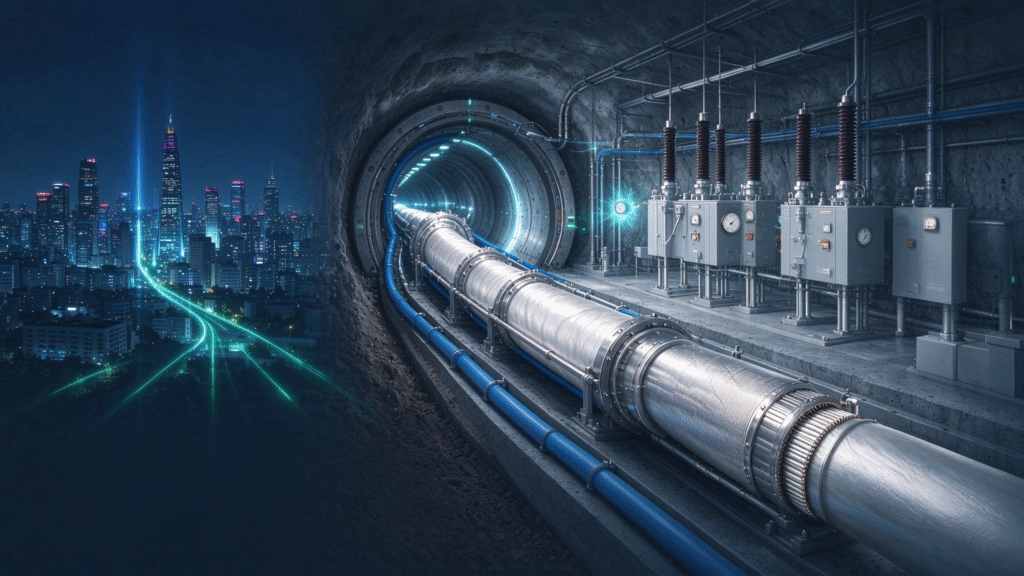
Installed beneath residential districts on Jeju Island, the cable can carry five times more electricity than conventional copper lines of the same diameter with almost no resistive power loss. The system uses liquid nitrogen for cooling and operates at roughly minus 196 degrees Celsius. It will run continuously for 24 months to collect data on reliability under changing weather, grid load shifts and ground vibration.
Engineers from the Korea Electrotechnology Research Institute (KERI) led the cable design and integration. The trial is intended to solve a well-known bottleneck on Jeju: limited space to lay new overhead power lines while local wind and solar capacity keeps expanding. Superconducting cables can boost transmission capacity without widening underground utility tunnels.
Researchers emphasise that the main remaining barrier is cost. Specialised tape materials and cryogenic cooling systems remain expensive. If the two-year trial delivers stable performance, KEPCO plans to draft standards for commercial superconducting cable deployment and seek partners for larger city projects.
Grid experts say the technology could become valuable for dense megacities and island energy hubs, where land for power infrastructure is scarce. Successful deployment would cut transmission waste and make it easier to integrate large volumes of renewable power into existing networks.