
Guangdong Province has been officially selected as one of China’s first provincial-level pilot zones for sixth generation mobile communication (6G) innovation under a coordinated central-local initiative, marking a major step forward in the province’s layout of next-generation communication technology and future industrial growth.
The three-year pilot scheme focuses on verifying new terminal hardware, core radio frequency devices, native operating systems and satellite internet integration. Researchers and local enterprises will carry out field tests targeting immersive communication, smart manufacturing, marine information networks, embodied intelligence and the booming low-altitude economy. Industry insiders note that these scenarios demand ultra-low latency, ultra-high reliability and seamless air-ground connectivity, which 6G is designed to support.
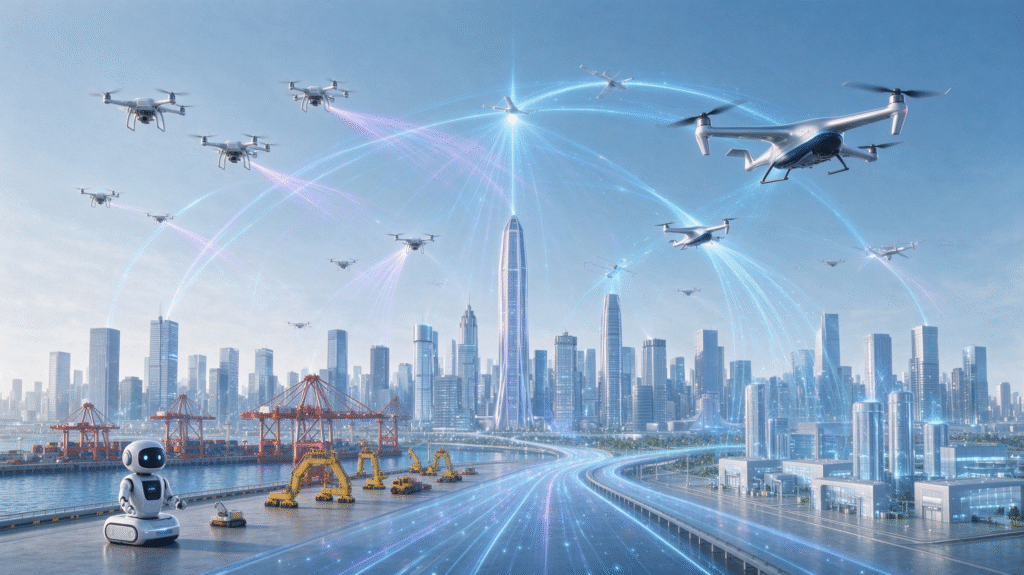
Key local firms based in Guangzhou and Shenzhen will deliver core components and system verification work. Companies specializing in radio-frequency front-end chips, industrial communication terminals and communication equipment will jointly build open test platforms, together with provincial branches of major telecom operators. The pilot also intends to form replicable technical standards and application cases for the Guangdong-Hong Kong-Macao Greater Bay Area.
As a national hub for digital manufacturing and artificial intelligence (AI), Guangdong boasts a complete information and communication industrial chain. The province has already rolled out preliminary demonstration projects for 6G-enabled millimeter-wave sensing and offshore communication. Officials said the 6G pilot will further combine local strengths in computing power, intelligent hardware and new-energy industries, accelerating the transformation from laboratory prototypes to commercial deployment.
The pilot cohort includes eight provincial and municipal regions nationwide. Each region will develop differentiated technical routes. Guangdong’s plan prioritizes linking 6G progress with low-altitude air traffic management, intelligent robots and coastal marine economy, to nurture new quality productive forces across the Greater Bay Area.