
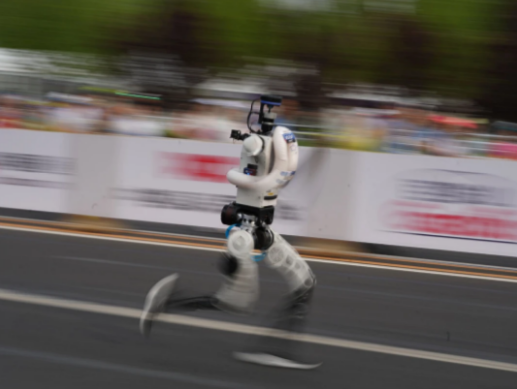
2026 Beijing Yizhuang Half Marathon & Humanoid Robot Half Marathon kicked off by the Tongming Lake in Beijing Economic and Technological Development Zone. This event, combining competitiveness and technological demonstration, attracted 12,000 human runners and more than 100 robot teams to compete on the same stage. Over 300 humanoid robots from 26 major brands staged a collision of technology and speed. Among them, the “Lightning” robot developed by Honor’s “Monkey King Team” won the championship with a net time of 50 minutes and 26 seconds, not only leading the robot category but also surpassing the human men’s half marathon world record of 57 minutes and 20 seconds, becoming the biggest highlight of the event.
Autonomous navigation becomes core battlefield, technological iteration astounds the audience
The core competitive focus of this year’s event centered on the autonomous navigation category. Nearly 40% of the participating teams broke free from remote control dependence, independently completing the 21.0975-kilometer race with the help of the robots’ own perception systems, positioning modules, and path planning algorithms. The championship-winning “Lightning” robot stands 169 centimeters tall with a mecha-style design. Its body structure draws heavily on the biomechanical characteristics of long-distance runners, optimizing stride length and frequency to improve running efficiency. Equipped with Honor’s self-developed integrated joint modules, the robot boasts a peak torque of 400 N·m, equivalent to the power level of high-performance automobiles; meanwhile, its efficient heat dissipation technology migrated from the mobile phone and laptop fields ensures that the motors remain at a safe operating temperature after long hours of high-intensity running, providing crucial support for stable performance.
The difficulty of the event’s track has been comprehensively upgraded compared to previous years, covering more than 10 complex terrains such as 8% steep slopes, 6% downhill sections, a total climb of 100 meters, road island obstacles, and continuous curves. This poses an extreme test for the robots’ environmental adaptability, dynamic balance control, and obstacle avoidance technology. Tiangong Ultra, the champion of last year’s event, participated in the fully autonomous mode this year and finished with a time of 1 hour and 15 minutes, accelerating by 1 hour and 25 minutes compared to last year, demonstrating remarkable technological progress; the Yushu H1 robot independently completed the 1.9-kilometer multi-curve race in the qualifying round, and its speed broke the human 1,500-meter world record when scaled proportionally, showcasing the breakthrough potential of humanoid robots in specialized sports capabilities.
Event drives technological breakthroughs, industry enters eve of large-scale mass production
From only 20 participating teams and 6 finishers in 2025 to more than 100 registered teams and nearly 40% completing the race with autonomous navigation in 2026, the leapfrog development of this robot half marathon intuitively reflects the explosive growth of China’s humanoid robot industry. Industry experts stated that the half marathon, as a stress test in extreme scenarios, is forcing the industrial chain to accelerate breakthroughs in core links – key technologies such as joint motor power density, sensor environmental perception accuracy, control algorithm real-time response speed, as well as high-energy-density batteries and lightweight structural materials, are all iterating rapidly through the “practical testing” of the event.
Industrial data shows that by 2025, the number of humanoid robot whole-machine enterprises in China has exceeded 140, with an annual shipment volume of 14,400 units, accounting for 84.7% of the global market share, making China the core gathering place of the global humanoid robot industry. As the performance evaluation system established by this event gradually becomes an industry-recognized benchmark, the unification of technical standards will further reduce industrial collaboration costs. The industry expects that 2026 will become a crucial starting point for the large-scale mass production of humanoid robots. The technological achievements previously focused on event “demonstrations” will accelerate their implementation in practical scenarios such as industrial inspection, logistics handling, home services, and smart elderly care, ushering in a new phase of “from technological breakthrough to commercial landing” for the humanoid robot industry.