
The 6th Radar Future Conference 2026 was held in Qingdao, Shandong Province, from April 18 to 20. Throughout the exhibition, one concept was repeatedly mentioned by attendees: intelligence-based reasoning.
On the opening day, the booth of the 14th Research Institute of China Electronics Technology Group Corporation (CETC) attracted massive crowds. Rather than traditional radar antennas, what drew the audience’s attention was a real-time monitoring screen. Echo signals of drones, birds, floating objects and other aerial targets were clearly displayed on the screen. According to the on-site staff, such targets used to be highly indistinguishable. By contrast, the current system can accurately identify drone targets, while automatically generating an analytical judgment: “Suspicious non-compliant low-altitude aircraft detected. Initiate control procedures”. Audience members commented with admiration: “It is not merely conducting detection, but also performing intelligent reasoning.”
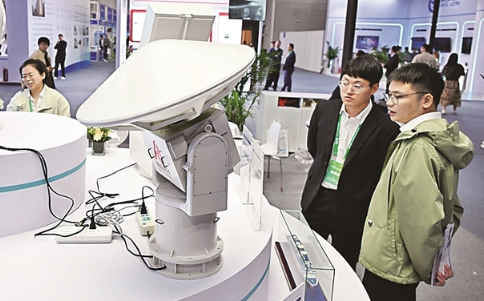
The concept of intelligent reasoning encapsulates the core transformation witnessed at this year’s conference. After nearly a century of development, radar technology is undergoing a profound evolution in function: It is shifting its competitive edge from long-range, high-resolution detection to intelligent interpretation and precise target identification. Wu Jianqi, Member of the Chinese Academy of Engineering and President of the China Radar Industry Association, pointed out in the main forum keynote address: “Radar is no longer a standalone detection apparatus. It has evolved into an integrated perception hub spanning air, space, ground, sea and electromagnetic domains, serving as critical infrastructure for national defense security, air-space defense, low-altitude airspace management, emergency disaster relief, and smart city construction.”
The transition from standalone detection equipment to core foundational infrastructure reflects the paradigm shift of radar technology from simple environmental sensing to advanced cognitive intelligence. Artificial intelligence constitutes the core enabler empowering radars with such cognitive capabilities.
Liu Hongchen, Director of the Strategy and Innovation Department of Guorui Technology Co., Ltd. under the 14th Research Institute of CETC, stated that the Tianxing “Spider Web” low-altitude surveillance radar series displayed at the event adopts advanced active phased array architecture. Integrated with multimodal data fusion and dynamic networking intelligent algorithms, the system achieves precise identification of low-altitude, small-sized, slow-moving targets amid complex urban clutter environments, supporting millisecond-level scanning and parallel tracking of multiple targets.
“This marks not only an upgrade in detection performance, but also a revolutionary advancement in low-altitude security management. These radars function as round-the-clock security sentinels”, Liu remarked.
Such intelligent cognitive capabilities are being extended across multiple technical domains. A typical example is the space debris detection system exhibited by the 23rd Research Institute of China Aerospace Science and Industry Corporation (CASIC). The system enables high-precision observation of on-orbit space objects, acquiring high-accuracy orbital parameters and characteristic data. According to institute engineers, empowered by artificial intelligence, the world’s first spaceborne Ka-band SAR radar payload developed by the institute has been deployed on orbit to provide intelligent remote sensing services including water resource monitoring, marine environment observation and emergency disaster response.
Wu Yirong, Member of the Chinese Academy of Sciences and Chairman of the Science and Technology Committee of the China Radar Industry Association, called on the industry to “proactively embrace the digital and intelligent technological revolution, deepen the integration of radar technology with diverse industries, and support national strategic development requirements”. This proactive integration empowers radars to evolve from passive responsive devices into active intelligent cognitive systems.
Equipped with autonomous cognitive capabilities, modern radars are rapidly expanding their application scope beyond traditional boundaries
The multi-wavelength cloud and precipitation detection radar, recipient of the First Prize in Science and Technology Progress Award from the China Radar Industry Association, realizes continuous full-process monitoring from thin cloud formation to intense precipitation events. Feng Kai, Senior Engineer from Aerospace Xinxian Co., Ltd. affiliated with the 23rd Research Institute of CASIC, explained that the system achieves microsecond-level synchronization precision for three-wavelength data. Combined with artificial intelligence algorithms, it accurately characterizes the microphysical evolution of cloud and precipitation particles, providing essential data support for precise meteorological forecasting.
This technological breakthrough underscores a distinct industry-wide trend. As analyzed by Wu Yirong, “Radar technology is accelerating its evolution toward multi-domain integration and high-performance functional enhancement.”
The realization of such evolution relies on robust underlying hardware and system infrastructure. At the core instrument and testing system exhibition area, a series of testing devices and integrated systems have reached leading industrial performance levels. Technical representatives from CETC Avionics Technology Co., Ltd. noted that a full industrial chain, systematic and intelligent layout spanning materials, components and integrated systems has been fully established.
“We will resolutely overcome bottleneck core technologies including high-end chips, build a fully independent and secure industrial chain, and firmly hold developmental autonomy in our own hands.” Wu Jianqi’s remarks highlighted firm strategic resolve. Indeed, sophisticated artificial intelligence algorithms remain unsustainable without independent underlying hardware support. The complete independent controllability of the industrial chain underpins China’s competitive advantages in developing intelligent cognitive radar technologies.
The conference hosted over 20 parallel forums covering cutting-edge fields including quantum technology, artificial intelligence, aerospace engineering, low-altitude economy, and integrated communication and sensing. Experts across disciplines shared latest research achievements and industrial insights from diverse perspectives. Cross-domain technological integration and frontline industrial exploration converge on a shared conclusion: emerging technologies showcased at the exhibition will soon be widely deployed to empower diverse industrial sectors. Wu Jianqi further elaborated on key pathways for industrial implementation: “Driving large-scale industrialization, standardization and marketization via technological innovation to transform radar from vital national strategic equipment into essential infrastructure for civilian livelihood applications.”
The intelligent cognitive revolution of radar technology is accelerating its transition from laboratory research to large-scale industrial implementation.