
Major comprehensive ground tests for China’s manned lunar landing program have been fully completed recently. All phases of the mission – lunar module landing, extravehicular activities on the lunar surface, and Earth-moon rendezvous and docking – ran flawlessly without a single malfunction. The news immediately topped national technology trending lists, with short video content covering the breakthrough racking up over 8 billion total views online, sparking nationwide excitement over China’s deep-space exploration milestone.
These ground trials represent the most systematic, full-scope and rigorous verification campaign ahead of actual crewed lunar missions. To replicate authentic lunar conditions as accurately as possible, researchers built high-precision simulation platforms recreating the moon’s harsh environment: low gravity, vacuum, extreme temperature swings of hundreds of degrees between day and night, and abrasive lunar dust. Engineers carried out hundreds of rounds of repeated testing targeting seven core technical bottlenecks of manned lunar travel, focusing on precision-powered soft landing control, closed-loop life support circulation systems, radiation and thermal protection for astronauts on the lunar surface, landing buffer shock absorption, and surface mobility support technologies.
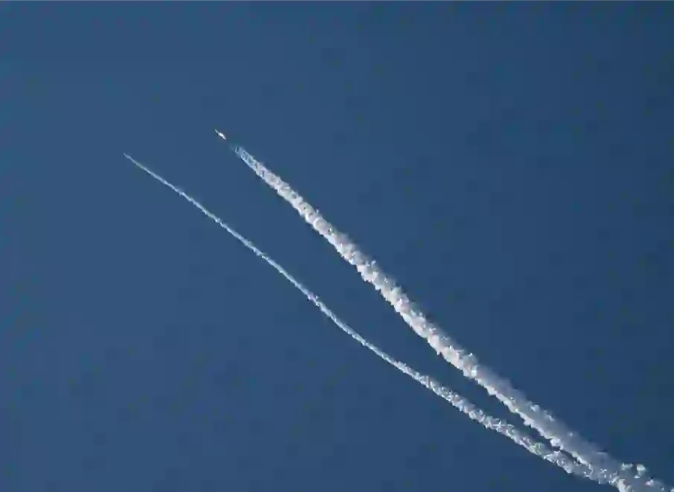
During on-site testing, the lunar lander prototype was suspended to simulate off-Earth low-gravity conditions. It autonomously ignited reverse thrust engines to regulate speed, completing hovering, obstacle avoidance and vertical descent sequences smoothly. Propulsion systems, telemetry and communication equipment, and thermal shielding structures maintained stable performance throughout every test run, with all measured parameters meeting design standards. The trials fully verified the lander’s safety and reliability under real lunar mission scenarios.
Supporting equipment for the program also delivered comprehensive technological leaps. China’s new-generation heavy-lift carrier rocket, tailor-made for manned lunar missions, passed matching joint tests, with thrust, carrying capacity and orbital injection precision fully meeting Earth-moon transfer and round-trip requirements. A brand-new generation of extravehicular spacesuits made its debut alongside the lander; optimized protective fabrics and integrated oxygen-temperature control systems are engineered to withstand intense lunar radiation and extreme temperatures, drastically extending astronauts’ endurance for long-duration surface walks.
Notably, every core component, microchip and special material used in the lunar module, rocket hardware, spacesuits and telemetry terminals for these tests was independently developed domestically. All key manufacturing processes and proprietary algorithms are fully mastered by Chinese research teams, eliminating reliance on foreign technology and establishing a complete, self-controlled industrial chain for manned lunar exploration.
Thousands of researchers, engineers and test operators from aerospace institutes, universities and manufacturing suppliers worked around the clock for years to deliver the trials on schedule and to exact quality standards. Faced with tight timelines, extreme technical complexity and challenges in coordinating multi-system joint debugging, teams adopted 24-hour shift rotations to record every set of test data. Minor deviations triggered overnight revisions to technical schemes, with tens of thousands of digital simulations and physical tests completed to eliminate potential hazards and guarantee maximum safety and stability for future crewed lunar missions.
Per China’s long-term crewed lunar exploration roadmap, upon finishing all ground verification trials, the program will move into the launch and execution phase, with plans to send Chinese astronauts to the moon within several years. Following initial crewed landing missions, China will begin constructing a long-term lunar science station. The permanent outpost will support systematic research including lunar mineral resource prospecting, surface space physics observation, exoplanetary life science experiments, and in-situ lunar resource utilization. These efforts will steadily build a comprehensive domestic system for Earth-moon space exploitation and research, accumulating critical technologies for long-duration human stays beyond Earth.
China’s deep-space exploration journey has unfolded in steady, unbroken strides. The Chang’e robotic missions pioneered lunar orbit, landing and sample return capabilities; the Tiangong Space Station now hosts regular long-duration astronaut habitation; and these successful full-process lunar landing ground trials mark the next giant leap forward. The manned lunar program drives far-reaching upgrades across high-end industrial sectors, including advanced new materials, precision electronics, intelligent automation, special propulsion and artificial intelligence. Spinoff aerospace technologies are already fueling progress in civilian manufacturing, medical care, energy and transportation, creating a positive cycle where space innovation boosts nationwide scientific advancement. Repeated landmark aerospace breakthroughs have also ignited widespread public enthusiasm for astronomy and engineering, especially among young people, spurring a national science popularization movement and nurturing a steady pipeline of young talent for China’s tech sector.
Netizens flooded social media to celebrate China’s aerospace progress. Many reflected on humanity’s ancient poetic dreams of traveling to the moon, now gradually transformed into tangible reality through fully verified domestic lunar hardware. Countless young students shared aspirations to join the aerospace industry and contribute to building the lunar research station. Industry experts highlighted that the successful conclusion of these comprehensive ground tests stands as a decisive milestone on China’s path to crewed lunar landing. By fully validating all ground-based engineering links, the trials lay an unshakable technical foundation for subsequent rocket launches, Earth-moon transit, astronaut surface operations and return missions, bringing the long-awaited moment when Chinese footsteps touch lunar soil ever closer.
The successful lunar lander trials are not an endpoint, but a new starting point for China’s deep-space exploration. Looking ahead, China’s aerospace sector will steadily advance a slate of major projects: manned lunar landings, a permanent lunar science station, asteroid reconnaissance and Mars sample return missions. Amid boundless starry skies, China will keep expanding humanity’s understanding of the universe, writing a new chapter of interstellar exploration powered by independent indigenous aerospace innovation.