
Overview: The hard-won core technology of space travel
Space rendezvous and docking (RVD) technology enables two high-speed orbiting spacecraft to meet accurately and dock perfectly in the vast cosmos, earning it the vivid nickname of “space needle threading”. As a pivotal technological breakthrough marking the maturity of China’s aerospace capabilities, this technology lays a solid technical foundation for lunar resource exploitation, interstellar exploration, extraterrestrial base construction and other future deep-space undertakings.
Outer space is not a static environment. Spacecraft orbiting Earth travel at nearly 7.9 kilometers per second, dozens of times faster than supersonic bullets. In the boundless space with no physical reference objects, guiding two independent flying vehicles to arrive at the same orbital position with identical speed and posture at the exact same time poses extreme challenges. The difficulty is comparable to threading a millimeter-scale needle eye with two high-speed flying fine needles at an altitude of 10,000 meters. A tiny deviation will lead to total mission failure.
As one of the three core technologies for manned spaceflight and deep-space exploration, space RVD is an essential capability for space station construction, crew rotation, space material resupply, on-orbit assembly of large spacecraft and extraterrestrial celestial exploration. For decades, this sophisticated technology has been monopolized by a handful of aerospace powers worldwide, featuring high technical barriers, enormous research and development difficulties and severe safety risks. Through years of independent research and dedicated efforts, Chinese aerospace engineers have achieved leapfrog development. The technology has evolved from manual control to fully autonomous docking, from prolonged docking procedures to rapid docking, and from single docking modes to all-phase and multi-directional docking.
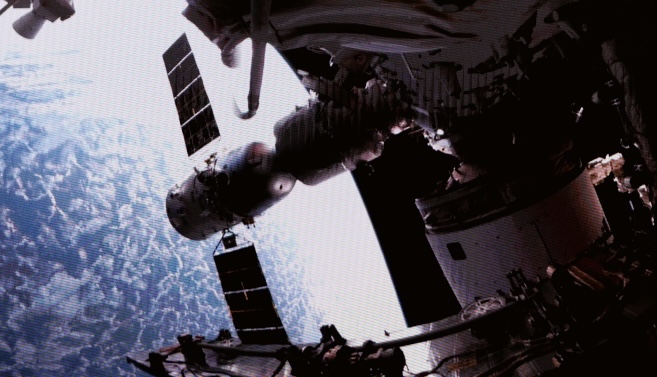
What is space rendezvous: Precision approaching in orbit
“Rendezvous” refers to the process in which chaser spacecraft such as spaceships and probes conduct precise orbital maneuvers and attitude adjustments under the coordination of ground measurement and control systems and on-board autonomous navigation systems. These continuous calibrations allow the chaser to gradually approach target spacecraft including space stations and orbital targets.
During the entire process, the spacecraft conducts multiple orbital parking and calibration operations to dynamically correct orbital deviations, ultimately completing accurate autonomous approaching in space. Microwave radar serves as the core equipment for the autonomous perception phase of RVD missions. It enables ultra-high-precision and real-time position sharing between two spacecraft. With centimeter-level measurement accuracy and millisecond-level update rate, the radar continuously transmits core operational parameters to the spacecraft’s guidance, navigation and control (GNC) system.
Supported by this system, high-speed flying spacecraft can steadily approach the target from a distance of thousands of kilometers down to tens of meters, achieving precise proximity for final docking.
The microwave radar system consists of two core components: an onboard radar and transponders. The RVD radar is installed on manned spaceships, while three uniquely numbered transponders are mounted on the Tianhe Core Module.
The radar actively emits electromagnetic waves carrying specific transponder codes. After receiving the signals, the transponders send back response signals to confirm their positions. The radar then captures, tracks and analyzes the feedback signals to achieve precise measurement and stable communication, laying the groundwork for successful spacecraft docking.
What is space docking: Locking and integrating space vehicles
Docking is the critical final locking and integration link of the entire mission. When two spacecraft reach predetermined positions, their docking mechanisms make precise contact.
The whole docking process includes four standardized procedures: flexible buffering, position correction, precision capturing and rigid locking. These steps eliminate relative speed and attitude deviations between the two vehicles, realizing cabin sealing and structural rigid connection. After successful docking, the two independent spacecraft are integrated into a single stable orbital complex. They achieve interconnected energy supply, real-time information interaction and shared orbital environment, forming a controllable unified space flight unit.
Technological upgrade: From long waiting to rapid autonomous docking
China’s mature all-phase autonomous rapid RVD technology supports 360-degree full orbital phase adaptive docking, eliminating the need to wait for strict orbital windows. The traditional docking cycle of two days has been greatly shortened to approximately 3.5 hours for manned missions, and merely 2 hours for cargo missions, significantly improving the flexibility and timeliness of space operations.
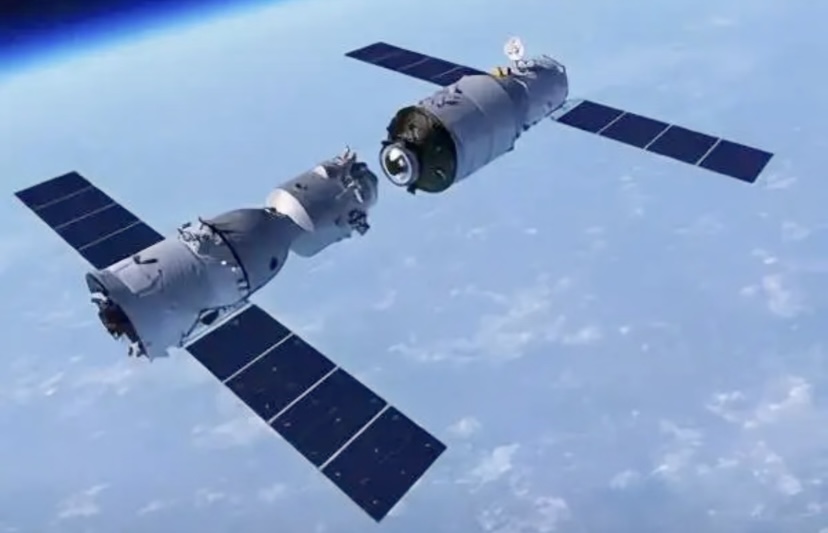
China’s RVD technology development is a continuous innovation and breakthrough journey. From 2011 to 2016, Shenzhou-8 to Shenzhou-11 missions adopted the first-generation microwave radar for RVD. At that time, a complete docking mission took around 44 hours from spacecraft orbit insertion to final locking, restricted by long operation cycles, rigid orbital window requirements and limited emergency response capabilities.
The application of the second-generation RVD microwave radar marked a new stage of technological progress. The new radar features optimized detection algorithms, enhanced anti-interference performance, expanded detection range and shortened response time.
It also realizes integrated measurement and communication functions. Beyond capturing precise motion data between spacecraft, it supports real-time information interaction and status synchronization, upgrading the capability from simple mutual perception to intelligent coordination.
The upgraded system greatly improves the automation and intelligence of docking procedures, adapting to full-phase docking modes including forward, backward and radial docking. It enables multi-port parking for the space station and multi-spacecraft collaborative on-orbit operations. With these advances, 6.5-hour rapid RVD has become a normalized capability, fully meeting the demands of regular crew rotation and space material resupply.
Lunar orbit breakthrough: Adapting RVD technology for deep space
Lunar exploration represents a country’s comprehensive national strength and aerospace technological prowess. Unlike low-Earth orbit (LEO), lunar orbit lacks satellite navigation support, making microwave radar the only effective long-distance measurement tool for lunar orbital RVD missions.
The complex space environment of lunar orbit raises stricter requirements for microwave radar systems, including miniaturization, low power consumption, wider measurement range, higher precision and dual-way communication functions. Each performance upgrade poses severe technical challenges.
Chinese research teams have conquered key technologies such as phase interferometer angle measurement and wide-angle high-precision measurement. The upgraded microwave radar delivers improved measurement accuracy, stable dual-way communication and enhanced resistance to lunar dust interference.
Building on the previous 50% weight reduction of the radar used in Tianzhou cargo spacecraft and Tiangong space station missions, researchers further reduced the equipment weight by 4.4 kilograms, achieving world-leading comprehensive measurement performance.
Leveraging this cutting-edge technology, the Chang’e-5 and Chang’e-6 missions successfully completed unmanned RVD in lunar orbit and accomplished lunar sample return missions.
Future prospects: Empowering long-term deep-space exploration
China’s mature space transportation and on-orbit docking system supports normalized operation of low-Earth orbit space infrastructure, regular crew and material transportation, and lunar resource exploration. It has built a stable operational ecosystem for China’s near-Earth space activities and laid the foundation for future extraterrestrial industrial development.
Looking ahead, with the steady advancement of major aerospace projects including manned lunar landing, lunar base construction and Mars exploration, China’s RVD technology will continue to iterate and upgrade. Future breakthroughs will focus on deep-space adaptation, intelligent operation, lightweight design and networked collaboration, empowering sustainable cislunar travel, deep-space exploration and extraterrestrial resource development.