
China successfully launched the Tianlian III-01 satellite into orbit on the evening of July 29th, 2026, from the Wenchang Spacecraft Launch Site in the southern island province of Hainan. The satellite was carried aloft by a Long March-7A carrier rocket at 7:50 p.m. Beijing Time and entered its preset orbit smoothly, marking the complete success of the mission. Developed by the China Academy of Space Technology, Tianlian III-01 is the first of China’s third-generation data relay satellites, representing a significant upgrade over its predecessors. The launch also marked the 659th flight mission of the Long March carrier rocket series.
The Tianlian III-01 satellite is primarily designed to provide data relay, telemetry, tracking, and command services for crewed spacecraft, including spaceships, space laboratories, and the Tiangong space station. It will also offer data relay and tracking support for medium- and low-Earth-orbit resource satellites. Data relay satellites function as orbital signal relay stations, maintaining continuous communication links between spacecraft and ground control. When crewed spacecraft orbit beyond the line of sight of ground tracking stations, these relay satellites bridge the communication gap, ensuring that astronauts remain in constant contact with mission control and that scientific data from space experiments can be transmitted back to Earth in real time.
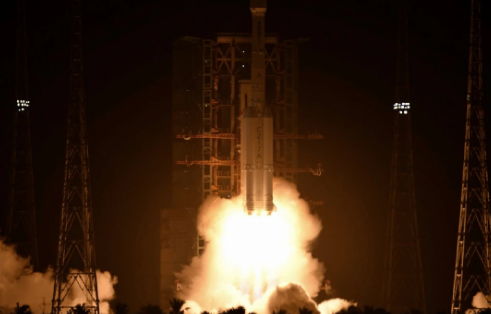
This launch represents a major technological advancement in China’s space infrastructure. Unlike the Tianlian I and II satellites, which were primarily launched from the Xichang Satellite Launch Center using Long March-3B and 3C rockets, the Tianlian III-01 was launched for the first time from Wenchang aboard a Long March-7A. The satellite features the more capable DFH-4 enhanced platform and a new-generation communication payload, enabling it to simultaneously serve a greater number of spacecraft and process multiple data streams in parallel with significantly improved capacity. The development team faced a tight schedule and considerable technical challenges, but through focused efforts on key technological breakthroughs and streamlined manufacturing processes, they ensured the satellite’s timely delivery. The Long March-7A rocket, developed by the China Academy of Launch Vehicle Technology, is a new-generation medium-lift launch vehicle capable of accommodating both 4.2-meter and 3.7-meter fairings and supporting single- or dual-satellite launches.
The Tianlian III-01 launch came just one week after the successful deployment of the Tianlian II-06 satellite on July 23rd, 2026. The Tianlian I series, consisting of five satellites launched between 2008 and 2021, established China’s first-generation global data relay network. The Tianlian II series, with its first satellite launched in 2019 and two additional satellites following in 2021 and 2022, completed the second-generation system, providing round-the-clock communication coverage for medium- and low-Earth-orbit spacecraft. With the arrival of the third generation, China’s Space-to-Earth communication network has been further enhanced, ready to support not only existing crewed spaceflight programs but also future deep-space exploration missions and a growing range of commercial satellite operations. The Wenchang Spacecraft Launch Site, which completed its 50th launch mission with this liftoff, is China’s first green, eco-friendly modern spaceport and is scheduled to host the Chang’e-7 mission later this year, along with future crewed lunar landing and heavy-lift rocket debut missions.