
The global smart glasses industry has achieved rapid development in 2026, driven by major tech firms including Huawei, Samsung, Meta and Alibaba Qwen. Fueled by lightweight hardware upgrades and embedded artificial intelligence (AI) agents, smart glasses have evolved from basic wearable gadgets into portable spatial computing terminals. Industry data shows global sales of smart glasses rose 106% year-on-year in the first half of 2026, marking the industry’s large-scale commercial breakthrough.
Hardware lightweighting stands as the key to market adoption. Updated manufacturing technologies have greatly reduced device weight: pure audio models weigh only 14.9 grams, camera-equipped versions range from 25.0 to 30.0 grams, and most augmented reality (AR) waveguide models stay under 40.0 grams. With wear comfort comparable to traditional eyeglasses, the products have solved long-standing issues such as ear slip and wearing fatigue.
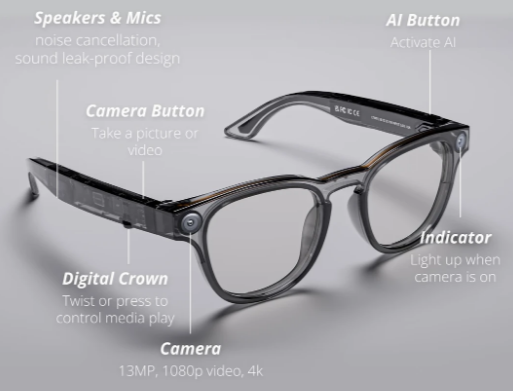
Leading brands have launched competitive new products with differentiated positioning. Huawei’s latest ultra-light smart glasses deliver outstanding portability. Samsung’s Galaxy Glasses, powered by Qualcomm’s dedicated AR chip, features a screen-free, regular-glass appearance with directional audio. Goertek’s new AI glasses offer 100° ultra-wide field of view and retina-level definition. Meanwhile, privacy-oriented camera-free models gain popularity, supporting multi-language real-time translation with low latency and 6-8 hours of daily battery life.
Industry competition has shifted from hardware specs to AI intelligence. Meta upgraded its Ray-Ban and Oakley smart glasses with the self-developed Muse Spark model, boosting semantic understanding and multi-task processing capabilities. A major milestone came at the 2026 World AI Conference, where Alibaba Qwen launched upgraded AI agent glasses. Unlike traditional passive voice devices, the new products support active scenario perception and autonomous decision-making. Equipped with full-duplex voice and eye tracking, they form a complete intelligent service loop for adaptive user experiences.
Maturing open-source ecosystems further accelerate industrial innovation. The integrated OpenClaw and Rokid development framework has attracted massive global developers, greatly lowering application development barriers. A wealth of vertical applications for office, navigation, education and industrial scenarios have emerged, realizing the practical value of smart glasses.
Currently, the market has formed a clear product hierarchy covering daily wear audio models, office heads‑up display (HUD) devices and high-end AR spatial computing products. As optical technology, dedicated chips and AI systems continue to mature, smart glasses are gradually replacing smartphones in high-frequency interactive scenarios.
Industry prospects remain promising. With continuous iteration of Apple’s AR optical technology, Android extended reality (XR) ecosystem optimization and domestic AI agent upgrades, the 2026 second half will witness further market expansion. Smart glasses are set to lead the new era of civilian spatial computing and reshape the wearable tech landscape.