
China’s embodied artificial intelligence industry has entered a new phase of large-scale industrial implementation, as a complete infrastructure system takes shape to accelerate the commercialization of humanoid robots and intelligent robotic systems, according to the latest industry report released by the China Academy of Information and Communications Technology (CAICT) on August 18th.
The newly published 2026 Research Report on Embodied Artificial Intelligence (AI) Training Grounds confirms that China has built and launched more than 70 standardized embodied AI training venues nationwide, forming a clustered and large-scale layout of industrial infrastructure. These dedicated training and testing bases cover core scenarios including industrial manufacturing, daily services, and special operations, effectively solving key bottlenecks in robot algorithm iteration, physical environment adaptation, and batch performance verification.
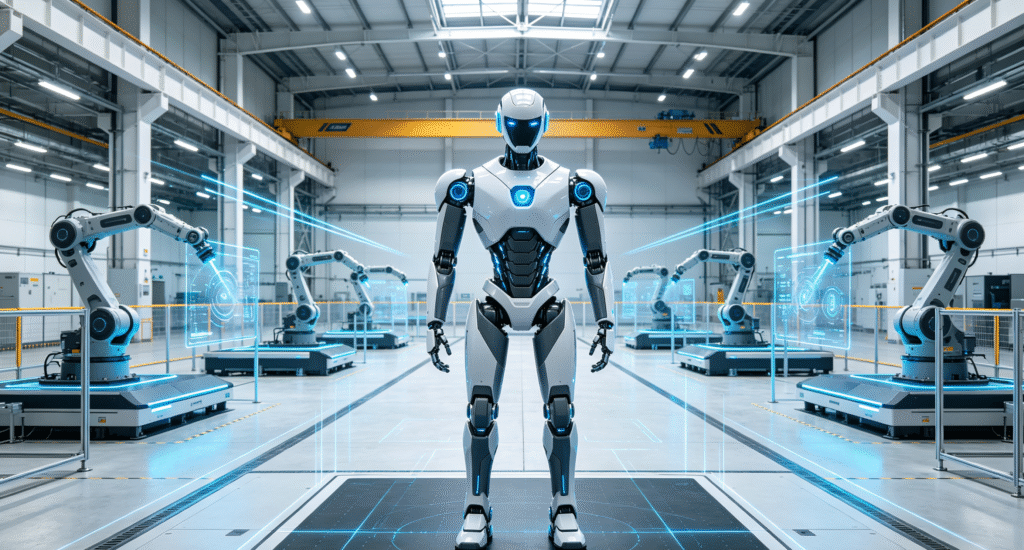
Different from traditional generative AI that focuses on digital content creation, embodied AI emphasizes the integration of artificial intelligence with physical entities, enabling robots to perceive, judge, and interact autonomously in real-world complex environments. The nationwide deployment of professional training grounds marks a critical shift for China’s robot industry: moving from laboratory demonstrations and prototype testing to large-scale industrial landing and commercial iteration.
The industrial breakthroughs are further backed by rapid technological upgrades of domestic humanoid robot products. Recently, Chinese robotics firm Unitree unveiled its new super-powered humanoid robot prototype, which sets impressive new performance records in motion capability. The robot achieves an extreme running speed of 12 meters per second and a vertical jump height of 2 meters, surpassing existing global records for humanoid robot athletic performance. Notably, the entire research and development (R&D) cycle of the new robot model took only over three months, demonstrating China’s rapidly improving rapid iteration capability in humanoid robot hardware and algorithm integration.
Industry analysts pointed out that the coordinated development of infrastructure construction and product technological innovation has built a closed-loop ecosystem for embodied AI industrialization. On one hand, standardized training grounds provide massive real-scene data support and repeated testing environments for robot algorithm optimization, greatly reducing the trial-and-error cost for enterprises. On the other hand, continuous breakthroughs in terminal robot performance further verify the practical value of embodied AI technology, driving accelerated penetration in manufacturing, logistics, public services and other fields.
Looking ahead, the embodied AI track is expected to become a core battlefield of global AI competition in the next two years. Driven by policy support, infrastructure improvement and technological iteration, China’s humanoid robot industry will gradually realize cost reduction and mass production. The industry predicts that with the continuous improvement of embodied AI training systems, intelligent robots will break through the limitations of fixed-scene applications and achieve flexible adaptation to diverse complex scenarios, unlocking trillion-level market space in the intelligent manufacturing and intelligent service sectors.