
The 2026 World Robot Conference (WRC), held from August 19th to 23rd in Beijing’s Yizhuang district under the theme “Human-Robot Symbiosis, Production-Demand Integration”, brought together more than 300 exhibitors and over 2,000 robotic products. The event featured more than 150 new products making their global debuts, a 21 percent increase year-on-year, with participating companies growing 36 percent from the previous year. Industry leaders and policymakers highlighted a decisive turning point: China’s robotics sector is moving from demonstration showcases to large-scale industrial deployment. According to the Ministry of Industry and Information Technology, the robotics industry’s revenue from enterprises above designated size exceeded 300 billion yuan in 2025, with the first half of 2026 reaching 165 billion yuan, up 24 percent year-on-year.
One of the most talked-about demonstrations at this year’s conference came from StarChart, which built the world’s first robotic micro-fulfillment center supporting online ordering and fully automated closed-loop fulfillment. The 1:1 replica of a real commercial warehouse allowed visitors to place random orders via a mini-program, after which robots autonomously identified products, planned paths, grasped and picked items, and completed packing – delivering a full end-to-end process from order to delivery. During the conference alone, the system processed 900 full-cycle orders, performed 1,775 picks, and completed 1,560 packing operations. StarChart’s founder and Chief Executive Officer (CEO) Gao Jiyang noted that the system handles tens of thousands of stock keeping units (SKUs) without requiring separate programming for each item, relying instead on model-based autonomous recognition. The company also demonstrated robots assembling other robots on-site, further underscoring its push toward production-ready solutions.
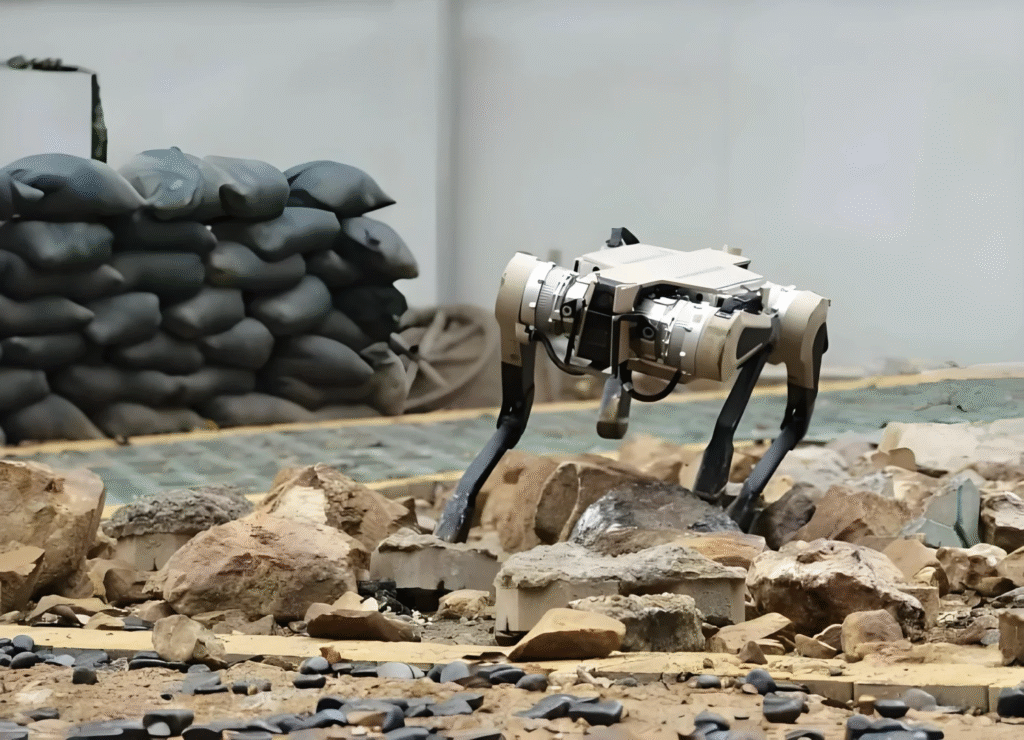
Beyond the showcase of new products, industry observers noted a fundamental shift in competitive dynamics. According to analysts at the conference, the focus of embodied intelligence competition is moving from isolated model capabilities toward a systematic engineering approach that integrates data, models, hardware platforms, and real-world scenarios. Companies are no longer displaying isolated walking, grasping, or motion control feats; instead, they are building capabilities around embodied intelligence models, world models, data collection, and simulation training. As one industry report put it, the competition is evolving from “hardware performance” to “comprehensive model-plus-data capability”. This shift reflects a broader recognition that robots must not only execute tasks but also understand the physical world to operate effectively in open environments.
The WRC 2026 made clear that China’s robotics industry has entered a new phase defined by practical application and commercial delivery. Unlike previous years when flashy stunts and acrobatic demonstrations drew the most attention, this year’s exhibitors focused on stable operations, fault tolerance, and maintenance costs. Companies including UBTECH Robotics Co., Ltd., Leju Robot, and Star Era displayed real-world industrial solutions spanning automotive manufacturing, logistics, and warehousing. The conference also saw the launch of the China Electronics Society’s World Model Expert Committee, chaired by academician Wang Jian, signaling growing institutional attention to foundational AI capabilities. With Chinese humanoid robot makers accounting for more than 97 percent of global shipments in the first half of 2026, the industry is rapidly transitioning from technology validation to scaled deployment – a transformation underscored by the 150-plus new products that made their debut at this year’s conference.