
Chinese aerospace researchers have successfully realized high-speed bidirectional laser communication between the earth and the moon for the first time, marking a major technological breakthrough in deep-space high-bandwidth transmission, according to the latest official announcement from China’s aerospace science and technology authorities.
Breaking through the technical bottlenecks of long-distance interference, dynamic tracking and signal attenuation in lunar-earth communication, the newly developed laser communication system has achieved stable and efficient two-way data transmission across the earth-moon orbital distance. Unlike traditional radio frequency communication widely used in deep-space exploration, laser communication features ultra-high bandwidth, stronger anti-interference capability and lower power consumption, effectively solving the long-standing problem of low-speed and low-efficiency data transmission in lunar exploration missions.
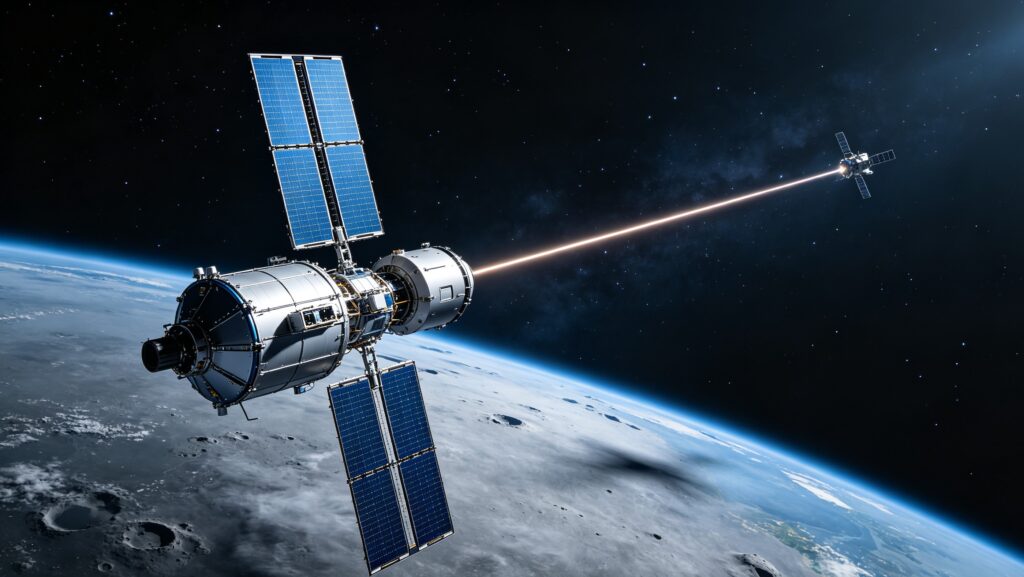
To achieve the milestone breakthrough, the research team optimized a full-set adaptive calibration technology. The innovative system comprehensively offsets multiple interfering factors including satellite orbital deviation, ground telescope installation errors, atmospheric refraction and real-time laser flight delay. It enables dynamic, high-precision alignment between space-based lunar orbit equipment and ground observation terminals, ensuring continuous and accurate laser signal docking during high-speed relative movement of the earth and the moon.
Industry insiders pointed out that traditional deep-space communication can only support the transmission of simple detection data and low-resolution images, which severely restricts the efficiency of lunar scientific research and exploration. The newly verified earth-moon high-speed laser communication technology can support ultra-large-capacity data transmission, including high-definition lunar surface videos, high-precision topographic mapping data and in-situ scientific exploration information.
This technological achievement lays a solid technical foundation for China’s subsequent manned lunar landing missions, lunar scientific research station construction and follow-up deep-space exploration projects. It will greatly improve the real-time transmission capability and data return efficiency of lunar exploration tasks, and provide reliable high-speed information support for long-term lunar scientific investigation, resource detection and deep-space astronomical observation.
As global deep-space exploration competition intensifies, high-speed laser communication has become a core key technology for next-generation aerospace exploration. China’s independent breakthrough in earth-moon bidirectional laser communication further enhances the country’s leading position in deep-space communication technology, and also provides a new technical solution for future international joint lunar exploration and deep-space scientific cooperation.