
A research team at Delft University of Technology has developed lightweight whisker-shaped tactile sensors that allow small drones to move safely through narrow, dark or obstructed environments where cameras and lidar perform poorly. Inspired by rodents’ facial whiskers, the new hardware detects gentle physical contact and instantly feeds location information back to the flight control system.
Traditional drones rely heavily on visual and laser ranging tools, which fail in smoky tunnels, dense pipe networks and shadowed indoor spaces. The newly designed tactile sensors are thin, flexible and low-cost, adding minimal weight to compact flying platforms. When a whisker touches a wall or obstacle, the drone adjusts its flight path immediately without needing clear sightlines.
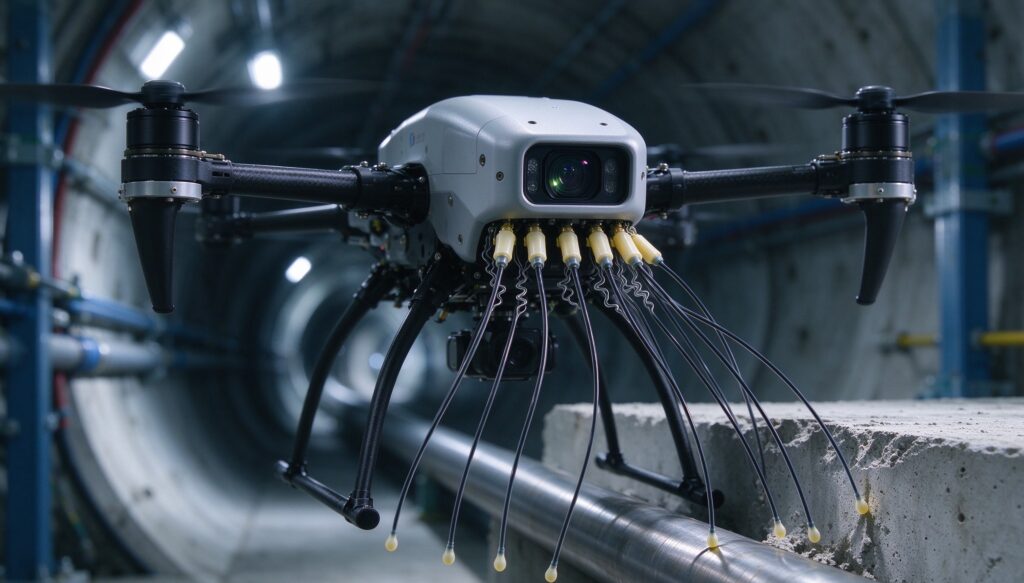
Each artificial whisker is built from flexible nitinol wire, with tiny pressure sensors mounted at the base to capture subtle bending forces the moment contact occurs. The whole sensing package weighs only a few grams, making it compatible with palm-sized micro-drones that cannot carry bulky navigation hardware. When a whisker bends against a surface, the sensors transmit contact data to the onboard flight controller within milliseconds. The embedded algorithm quickly calculates the contact position and surface distance, adjusting the drone’s speed and heading before a hard collision takes place. Researchers noted that the system is designed to filter out interference generated by the drone’s own spinning propellers, which can create airflow disturbances and false readings. Unlike vision-based systems that require clear light and unobstructed line of sight, these whiskers rely purely on mechanical touch, maintaining stable sensing performance even when dust, smoke or total darkness renders cameras and lidar useless.
In lab and field tests, the prototype drones successfully explored tight maze-like structures and avoided repeated collisions. Researchers explained that this touch-based navigation system fills a long-standing gap in robotic sensing. It can support industrial inspection tasks, including checking aging pipelines, underground infrastructure and collapsed building zones after disasters.
The team stated that the current prototype will be optimised for mass production in the next two years. Future versions may combine whisker sensors with basic acoustic detectors to further boost reliability in harsh conditions. This technology is expected to open new opportunities for infrastructure maintenance and emergency search missions.
Industry observers note that tactile sensing for aerial robots remains underdeveloped compared with optical sensing. This breakthrough offers a practical alternative for environments where visual sensors cannot function, expanding the real-world usability of small unmanned aircraft.