
A viral stunt in which retired humanoid robots autonomously walked and leaped into a 1,500°C steel furnace in Finland has ignited worldwide discussions over robotics ethics, corporate marketing and the boundary between programmed action and machine agency.
Conducted by the United States (US) humanoid robot startup Figure artificial intelligence (AI) on September 30th, the event saw its F.02 robot fleet complete their final task without remote human control: navigating to the edge of a 75-ton electric arc furnace and jumping into molten steel. The scene directly pays homage to the classic ending of Terminator 2, where Arnold Schwarzenegger’s T-800 voluntarily submerges itself in molten metal. Schwarzenegger himself attended the furnace site in protective gear to witness the retirement.
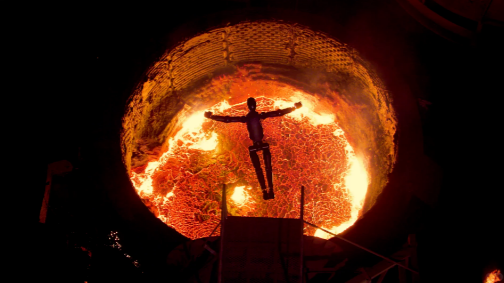
These F.02 robots previously worked on Bayerische Motoren Werke (BMW) production lines for thousands of hours, assembling automotive parts. As newer F.03 and F.04 models entered development, the firm decided full destruction was more practical than manual disassembly. Dismantling each unit would consume heavy engineering resources and risk leaking proprietary motor, sensor and AI intellectual property. Many foundries rejected the risky plan due to safety concerns over the robots’ lithium-ion batteries, before the Finnish casting plant agreed to host the melting.
Engineers trained the robots’ AI to execute the full sequence: positioning, approaching the furnace rim and executing the jump. The team ran repeated simulations and safety tests in California before the live demonstration. Footage of the humanoid disappearing into roaring flames spread rapidly online, drawing mixed reactions.
Many viewers were captivated by the cinematic recreation, yet ethicists raised sharp questions. Experts note the robot had no subjective consciousness. Its “self-sacrifice” was merely pre-programmed motion. Still, the spectacle stirs sensitive ethical puzzles: How should society frame robot retirement and end-of-life disposal? When firms stage dramatic autonomous actions for viral publicity, where lies the line between engineering demonstration and misleading public perception of AI agency?
Critics argue the event is primarily a polished marketing campaign that risks distorting public understanding of AI. Others acknowledge that secure disposal of robotic hardware is a real industrial challenge, and the case highlights a largely overlooked area in robot governance: lifecycle management for humanoids, covering manufacture, deployment, decommissioning and data erasure.
Scholars in tech ethics warn that as humanoids enter factories, workplaces and daily life, clearer rules must govern their retirement. “This robot did not choose death. Humans wrote every line of code,” one AI ethicist commented. “The bigger ethical question is whether we are carefully enough managing public expectations while designing responsible decommissioning standards for intelligent machines.”
Industry observers add that the incident underscores a recurring tension in advanced robotics: spectacular demonstrations capture public attention, yet ethical guardrails must keep pace as humanoid technologies mature.