
A research team led by Professor Wenhua Zhang at Yunnan University has unveiled a field-validated perovskite photovoltaic system capable of continuous power generation 10-metre below the ocean surface, marking a major milestone for marine distributed energy. The full findings of the programme have been published in Joule, after a series of lab calibrations and open-sea trials carried out in the South China Sea.
For decades, underwater electronic systems have relied almost entirely on pre-charged lithium battery packs or cabled power from surface vessels. Both approaches carry clear drawbacks: Batteries must be recovered, replaced and recharged on a fixed schedule, which raises operational costs and creates data gaps during servicing. Cabled power, meanwhile, restricts the mobility of autonomous sensors and unmanned submersibles and is vulnerable to damage from currents, fishing gear and seabed movement. Traditional silicon solar panels are not a viable workaround here, because seawater rapidly absorbs red and infrared wavelengths, leaving only blue-green light available below the surface. Standard silicon cells are optimised for the full terrestrial solar spectrum and lose most of their conversion capacity once submerged deeper than one or two metres.
The Yunnan University group solved this spectral mismatch by engineering a wide-bandgap perovskite composition with a bandgap of roughly 1.96 eV, tuned specifically to absorb blue-green light that travels through seawater. The team also developed a multi‑layer polymer encapsulation structure that blocks salt ions, resists biofouling and suppresses lead leakage even under prolonged immersion. During the South China Sea field test, the optimised module maintained a stable underwater power conversion efficiency of 34.71%. Accelerated ageing tests predict a service life of around 5.5 years under coastal seawater conditions, far exceeding the durability of earlier shallow‑water perovskite prototypes.
The technology targets a wide range of blue-economy infrastructure. It can support long-term ocean environment monitoring networks that track water temperature, salinity, acidification and sediment movement. It may also power pipeline inspection nodes, underwater seismic recorders, coastal disaster early‑warning stations and small autonomous underwater vehicles used for fishery resource surveys. Unlike tidal or wave energy generators, these perovskite modules have no moving parts, can be manufactured compactly and deployed in scattered, remote coastal zones. Researchers stressed that the system is not meant to replace large offshore renewable farms. Instead, it fills the niche of low‑power, off-grid subsea devices where wiring and frequent battery swaps are impractical.
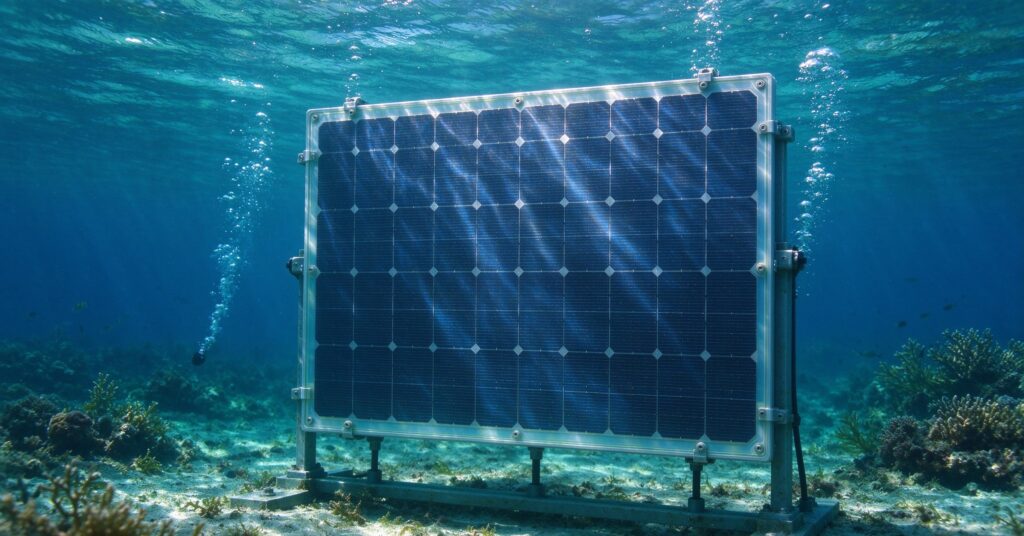
Professor Zhang noted that nearly all prior underwater solar demonstrations were limited to depths of two metres or less, which confined them to near-shore surface buoys. “Moving stable, usable solar power down to 10-metre opens a new design space for marine observation”, he explained. “We are no longer forced to place every instrument within easy reach of the air”. Still, the team identified remaining engineering hurdles. The current modules are relatively small, and pressure resistance must be strengthened for deployment at greater depths. Biofouling, the gradual build‑up of algae and shell growth on the cell surface, will require low‑impact anti‑fouling coatings to retain performance through multi-year missions.
Industry analysts in marine energy said the breakthrough could lower the total cost of ocean observation arrays over their lifecycle. If scaled successfully, the low-cost perovskite route may become a standard complementary power source alongside tidal energy in integrated marine energy layouts. The research team’s next work plan includes scaling up module size, refining encapsulation for deeper water and running year‑round exposure trials in different marine environments, from brackish estuaries to clearer offshore waters.
International marine scientists have welcomed the results, pointing out that persistent power shortages have long slowed the expansion of global ocean sensing networks. Reliable underwater photovoltaics could help expand continuous ocean data collection, supporting climate modelling, pollution tracking and sustainable marine resource management.