
Tesla has finally pulled back the curtain on its long-delayed second-generation Roadster during a special event hosted at SpaceX’s McGregor test facility in Texas, where the prototype stole the show with a breathtaking autonomous aerial flip demonstration that immediately ignited worldwide discussion about the prospect of a functional “flying Tesla”.
Held within a secured, closed-test zone, the high-octane stunt captured attention online shortly after it wrapped. The white Roadster accelerated hard along a custom-built curved ramp, holding itself inverted against the surface for a short period using an onboard negative-pressure system. It then broke free from the track, launched into open air, completed a controlled mid-air roll, soared over a row of stationary vehicles, and landed steadily back on the ground. Footage of the unusual manoeuvre spread rapidly across major social media platforms, drawing millions of views and splitting opinions among automotive and aerospace enthusiasts.
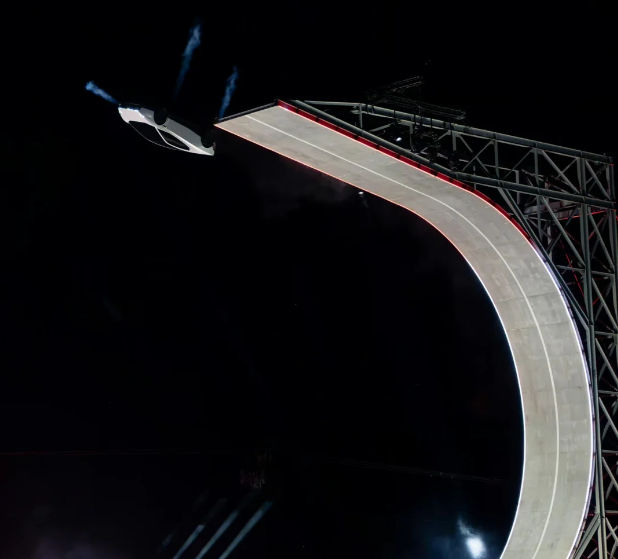
The vehicle’s limited airborne performance relies on a bespoke cold-gas thruster system co-engineered by Tesla and SpaceX. Derived from the attitude-adjustment thrusters used on orbital rockets, this system releases pressurized inert gas to create directional thrust. It is critical to note that this design differs fundamentally from rotor-powered electric Vertical Takeoff and Landing (eVTOL) craft. The stored gas supply only supports very brief bursts of lift and attitude correction, making sustained flight impossible. At this stage, the high-powered rocket variant fitted with the full thruster array is authorised exclusively for trials on private test grounds and cannot be legally driven on public roads.
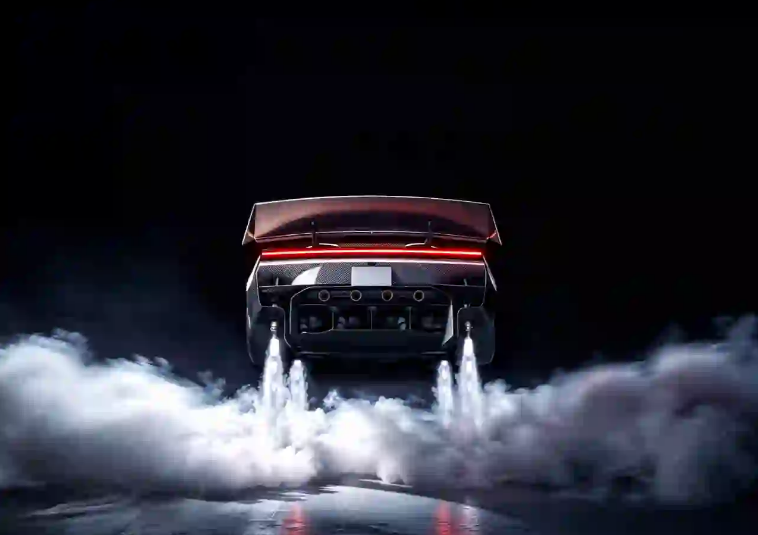
Tesla has laid out three distinct configurations for the new Roadster: the standard Performance model, the intermediate Thrust edition, and the ultra-limited, invitation-only Rocket version equipped with the complete cold-gas propulsion package. According to official performance figures released at the event, the top-tier Rocket variant can sprint from 0 to 96 km/h in 0.81 seconds, with a claimed maximum speed exceeding 370 km/h. The company targets the start of mass production for 2028. For buyers in China, reservations for the Performance trim are already available, requiring a fully refundable deposit of 332,000 yuan.
Elon Musk addressed the crowd during the presentation, calling the redesigned Roadster “one of the last great performance cars built for human drivers.” He emphasised that the programme’s purpose extends far beyond creating a fast electric supercar. In his view, the Roadster serves as a hands-on engineering test platform, designed to explore how mature aerospace technologies can be adapted and deployed for land-based passenger vehicles.
Independent industry analysts have cautioned audiences against conflating this demonstrator with commercially ready flying air taxis. The cold-gas thruster setup is optimised for short, dramatic stunts and transient speed boosts, rather than reliable, day-to-day urban air mobility. A long list of formidable barriers still stands in the way of public operation, including strict airworthiness certification standards, integrated low-altitude air traffic management frameworks, noise control requirements, and comprehensive safety regulations.
Globally, the low-altitude economy has become one of the most hotly contested emerging sectors, with dozens of companies pouring resources into eVTOL development and related infrastructure. Even so, Tesla’s latest showcase remains a striking boundary-pushing engineering spectacle rather than a practical solution for airborne commuting. It poses a thought-provoking question for the whole mobility industry: Where exactly lies the dividing line between a high-performance car and a flying machine?