
A research team has reported a new world record for flexible perovskite-silicon tandem photovoltaic devices, achieving a certified power conversion efficiency of 29.8 percent on full-size silicon wafers and 33.6 percent on small-area test cells. The breakthrough addresses two long-standing barriers for flexible solar technology: low stability and poor mechanical endurance.
Unlike rigid solar panels widely used on rooftops and power plants, the new cells are built on thin, bendable substrates. In accelerated durability tests, the devices retained 97.0 percent of their original output after more than 43,000 bending cycles. The protective coating developed by the group shields the light-absorbing perovskite layer against moisture, ultraviolet radiation and sharp temperature swings, conditions that normally cause rapid performance decay.
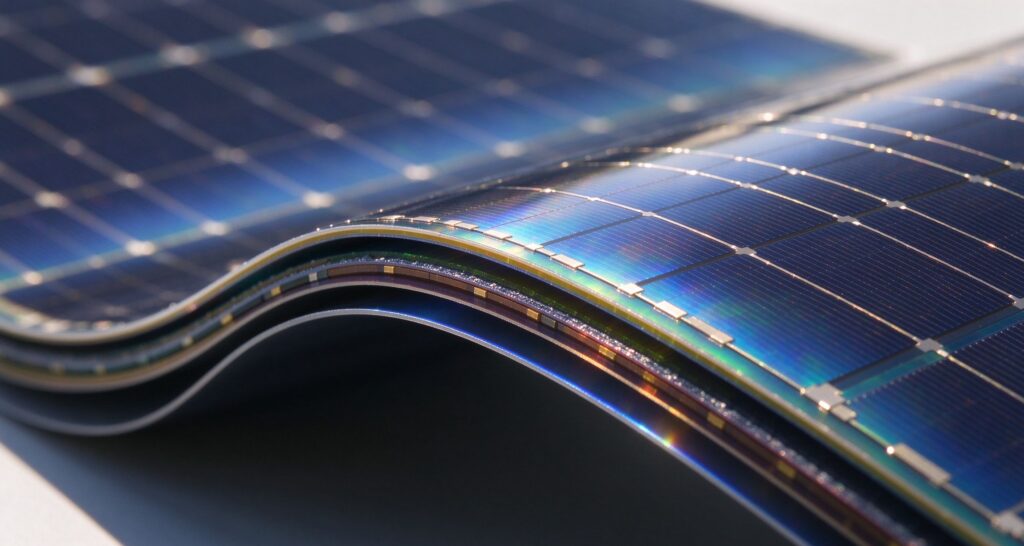
Tandem stacks combine perovskite and silicon layers to capture different segments of the solar spectrum. Silicon absorbs red and infrared light, while perovskite efficiently harvests visible blue and green wavelengths. This layered design pushes efficiency beyond the practical ceiling of single-junction silicon cells, which has stayed near 26.0 percent for years.
Engineers say the flexible format opens new application scenarios that traditional panels cannot serve. The lightweight cells can be wrapped around vehicle surfaces, integrated into curved building facades, attached to drone wings and deployed quickly in remote field stations or disaster-relief sites. The team also noted that the manufacturing process is compatible with existing silicon production lines, which could reduce the cost of scaling up.
Industry analysts commented that stable, high-efficiency flexible tandem cells will strengthen the competitiveness of distributed solar power. The next phase of the project will focus on scaling the certified performance to large-area modules and lowering material costs for mass production. Field trials with building-integrated photovoltaic systems are scheduled to start in the first half of 2027.