
Amid intensifying competition in the memory chip sector, Chinese manufacturers are moving into the high-end market with faster iteration cycles. On November 12th, ChangXin Memory Technologies (CXMT) disclosed the latest progress of its double data rate 5 (DDR5) product line, with the most notable figure being its multiplexed rank dual inline memory module (MRDIMM) reaching speeds of up to 12800 Mbps – a metric that has now entered the mainstream international tier.
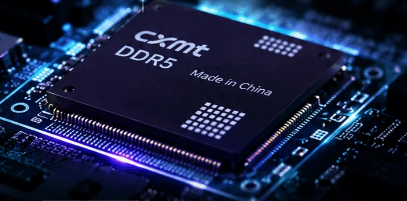
According to CXMT’s disclosure, its DDR5 dies have completed the iteration from 24Gb to 32Gb, with higher per-die density enabling further optimization of module density within the same package size. At the module level, RDIMM products cover capacities from 32 GB to 128 GB with speeds ranging from 5600 Mbps to 8000 Mbps, meeting the needs of mainstream server platforms. The MRDIMM line, aimed at higher-bandwidth scenarios, offers 128 GB and 192 GB capacity options with top speeds reaching 12800 Mbps.
CXMT also outlined its roadmap: its first-generation DDR5 RDIMM products based on four F squared (4F²) architecture are expected to be sampled by the end of this year, targeting servers and other applications with stringent bandwidth and stability requirements. The 4F² cell architecture is regarded as one of the key paths for dynamic random access memory (DRAM) scaling, with potential advantages in improving memory density and energy efficiency.
The development comes as the global memory chip market enters an upcycle driven byartificial intelligence (AI) computing demand. Earlier this week, Semiconductor Manufacturing International Corporation (SMIC)’s third-quarter report showed capacity utilization reaching 97.3%, up from 93.7% in the second quarter, with net profit rising 87.6% year-on-year. High utilization at the wafer manufacturing level corroborates the synchronized strengthening of demand for both memory and logic chips downstream.
Still, competition in the DDR5 race remains fierce for CXMT. Samsung, SK Hynix, and Micron have been deployed in high-end server memory segments such as MRDIMM for years and are advancing DDR5 products based on more advanced processes. While CXMT’s disclosed speed figures are competitive, mass-production consistency, customer qualification progress, and ramp-up speed will be the key variables determining whether it can secure a foothold in the server supply chain.
From an industry perspective, the leap from double data rate 4 (DDR4) to DDR5 by domestic DRAM makers is not merely a technology-node advance – it also means that in core infrastructure areas such as data centers and cloud computing, the autonomy of local memory supply is gradually strengthening. As 4F²-architecture products head toward sampling by year-end, whether CXMT can narrow the generational gap with leading manufacturers in the next phase of high-end memory competition warrants continued attention.