
On November 10, at the Hainan Commercial Space Launch Site, the Long March 12 carrier rocket successfully deployed 13 satellite clusters into their predetermined orbits. This mission marks a significant step forward in China’s efforts to build a low-orbit satellite internet constellation, injecting fresh momentum into the country’s space-based network infrastructure. Although this launch was not explicitly labeled as part of the “Thousand Sails Constellation”, it aligns closely with China’s broader satellite internet strategy. Together with initiatives like the Thousand Sails Plan, the mission represents a core project in advancing the country’s low-orbit satellite network and demonstrates tangible progress in commercial satellite deployment.
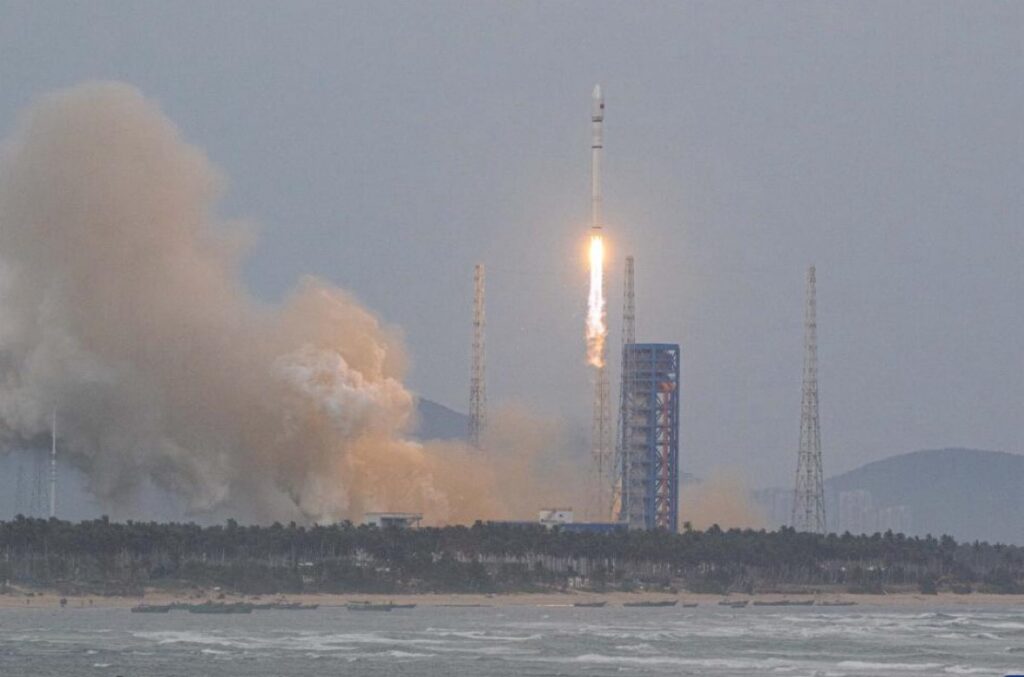
As a new-generation commercial carrier rocket, the Long March 12 showcased several notable features in this mission. It adopted a “three-in-one” integration and testing model, along with zero-window launch technology. With a 12-ton payload capacity to low Earth orbit (LEO), the rocket efficiently supports multi-satellite network deployment. Even its specialized high-reflectance protective coating was tailored to withstand Hainan’s high-temperature environment, addressing key challenges during launch operations. Dubbed a “fast and smooth vessel” within the industry, the Long March 12 has become a preferred launch vehicle for commercial satellite networks, thanks to its cost-effectiveness and high reliability. Prior to this mission, it had already undertaken multiple LEO satellite launch tasks, accumulating extensive operational experience.
Meanwhile, the Thousand Sails Plan – a key commercial LEO broadband satellite constellation – is positioned as a “space-based station cluster”. This year marks the beginning of its large-scale deployment phase, with plans to complete the launch of over 15,000 satellites by 2030. The successful launch of the 13 satellite clusters echoes the smooth orbital insertion of the sixth batch of Thousand Sails networking satellites in October, jointly boosting China’s in-orbit LEO satellite count.While these two projects are operated by different entities, they share the common national goal of building an integrated “space-ground” satellite internet system. They also exhibit strong synergy in technical routes and application scenarios and are expected to jointly support commercialization in areas such as low-altitude economy and emergency communications.
Supported by policies from the Ministry of Industry and Information Technology and the growing maturity of the commercial aerospace industry chain, China’s satellite internet has entered a critical phase of “high-frequency launches + large-scale networking”. This launch not only marks the 607th flight of the Long March rocket series but also highlights China’s end-to-end capability across the entire industry chain – from satellite manufacturing and rocket launches to application services.This capability lays a solid foundation for the continued advancement of constellation projects such as the Thousand Sails Plan, bringing the world closer to an era of global connectivity through space.