
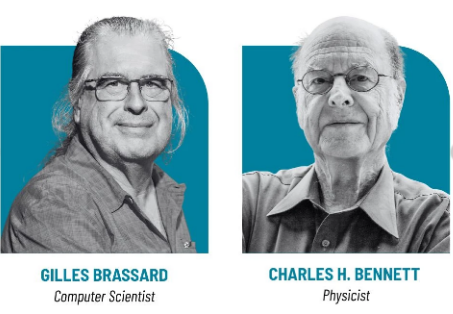
The ACM A.M. Turing Award, known as the “Nobel Prize of Computing”, marked a historic milestone today – the Association for Computing Machinery (ACM) officially announced that the 2025 award will be conferred upon Charles H. Bennett, a researcher at IBM in the United States, and Gilles Brassard, a professor at the University of Montreal in Canada. This recognition celebrates their groundbreaking contributions to laying the foundation of quantum information science and revolutionizing global secure communication and computing systems. It is the first time since the Turing Award was established in 1966 that the honor has been bestowed upon researchers in the quantum information field, signifying the interdisciplinary subject’s formal recognition as a cornerstone of computer science.
Interdisciplinary titans: Four decades building the theoretical framework of quantum information
The two laureates stand as a model of interdisciplinary collaboration. Physicist Bennett and computer scientist Brassard have dedicated four decades to the intersection of quantum physics and information science since their first meeting in 1979, constructing the theoretical framework of quantum information science from scratch. ACM President Yannis Ioannidis commented: “They fundamentally transformed our understanding of the nature of information, expanded the boundaries of computing, and their insights continue to inspire interdisciplinary innovation to this day.”
Their core contributions center on three landmark breakthroughs: In 1984, they proposed the world’s first practical quantum cryptography protocol, BB84, which for the first time translated quantum mechanical principles into a tool for information security, enabling “eavesdropping-detectable” absolutely secure communication. In 1993, they jointly put forward the theory of quantum teleportation, proving that quantum states can be transmitted over long distances through entangled particles and laying the foundation for quantum networks; In 1996, they developed entanglement distillation technology, solving the optimization problem of low-quality quantum entanglement and becoming a key enabler for large-scale quantum communication. These achievements not only overturned traditional perceptions of computing and communication but also directly drove quantum technology from the laboratory to industrialization.
Technological revolution: Reshaping the landscape of secure communication and computing power
The birth of the BB84 protocol represents an epoch-making significance. Unlike traditional encryption systems that rely on mathematical puzzles, the security of BB84 is rooted in fundamental physical laws such as quantum non-cloning and measurement disturbance, making it unbreakable even against fully mature quantum computers of the future. Today, its improved versions are widely adopted worldwide: China’s “Micius” quantum satellite has achieved thousand-kilometer-level satellite-ground key distribution, the “Beijing-Shanghai Trunk Line” has built an optical fiber quantum secure communication network spanning over 10,000 kilometers, and China Telecom’s “quantum encrypted calls” service now covers nearly 6 million users.
In the field of computing power, the pioneers’ theories provide core support for quantum computing. Leveraging characteristics such as superposition and entanglement, quantum computing is poised to achieve “exponential leapfrogging” over classical computers in scenarios including drug discovery, new material design, and complex system optimization, emerging as a critical driver for the next generation of artificial intelligence and industrial upgrading. Jeff Dean, Chief Scientist at Google DeepMind, noted: “Their visionary insights laid the groundwork for today’s most exciting technological frontiers, continuously influencing basic research and practical innovation.”
Global upsurge: Quantum technology becomes a focus of great power competition
The announcement of this year’s Turing Award coincides with the United Nations designating 2025 as the “International Year of Quantum Science and Technology”, reflecting the vigorous development of the global quantum field. Currently, major initiatives such as the EU’s “Quantum Flagship” program, the U.S. “National Quantum Initiative”, and Europe’s Quantum Communication Infrastructure (EuroQCI) have been successively launched, with more than a dozen quantum communication satellites worldwide set to be launched – marking the entry of quantum technology into the era of large-scale deployment.
For China, quantum information has been listed as a key direction of national strategic emerging industries, with a series of internationally leading achievements in quantum communication, quantum computing, and other fields. Industry experts stated that the Turing Award’s recognition of the quantum field will further promote China’s investment in talent cultivation, scientific research, and industrial layout, helping quantum technology leap from “keeping pace” to “leading the way”.
Century-old legacy: Basic research illuminates the future
Notably, Brassard’s doctoral advisor was John Hopcroft, the recipient of the 1986 Turing Award. Forty years later, the teacher and student have successively stood on the same podium, becoming a touching story of scientific inheritance. The two laureates have devoted decades to basic research, transforming a once “niche field” into a mainstream of the times. Their journey confirms the foundational role of basic scientific breakthroughs in driving technological revolutions.
The Turing Award carries a prize of $1 million, sponsored by Google. The two scientists emphasized that the honor belongs not only to individuals but also to all researchers in the quantum information field. As technologies such as fault-tolerant quantum computers and long-distance quantum networks continue to advance, quantum technology will further reshape the digital economic landscape, unlocking boundless possibilities for human social development.