
On March 19th, international gold prices briefly fell below the $4,700 mark. As of 16:50 Beijing time on March 19th, spot gold was trading at $4,710 per ounce, down over 2%; COMEX gold was at $4,706 per ounce, down more than 3%. On the evening of March 18th, international gold prices experienced a short-term sell-off, successively breaking through the $4,930, $4,920, and $4,900 per ounce levels.
“The safe-haven logic hasn’t failed, but its primary position has been ceded to the logic of a stronger US dollar,” said Tian Lihui, Dean of the Institute of Finance and Development at Nankai University. He pointed to a deeper analysis, describing it as a classic “oil price backlash against gold” transmission chain: war pushes up oil prices, oil prices fuel inflation, inflation suppresses rate cut expectations, and ultimately gold becomes a victim of the high-interest-rate environment.
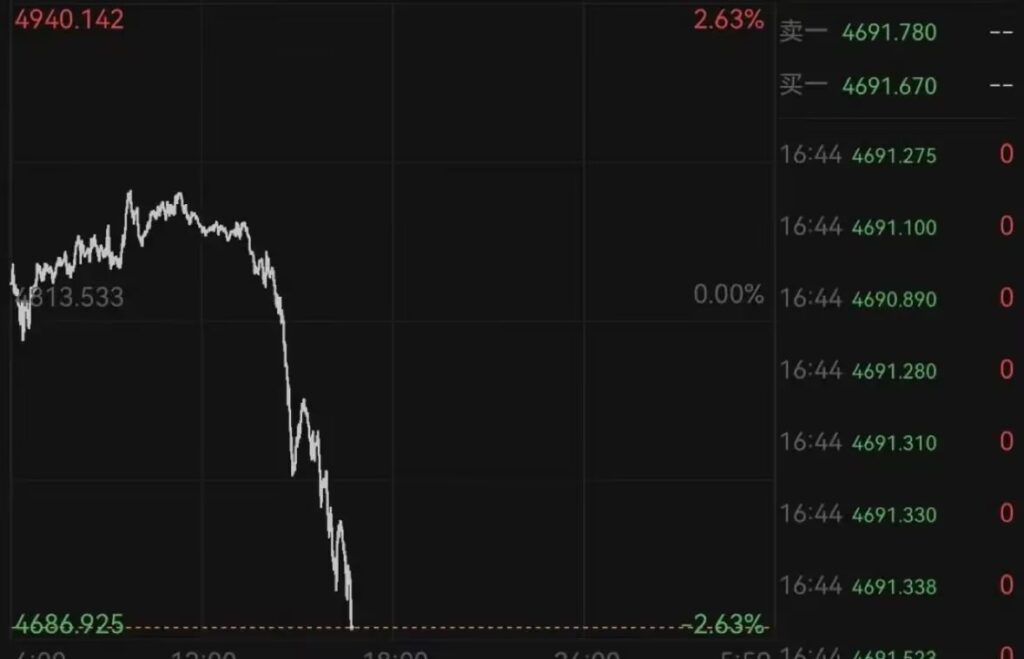
In early March, the spot gold price briefly surged above $5,400 per ounce during trading but has since seen a significant correction and overall downward fluctuation. On March 18th, international gold prices broke below $4,900 per ounce, with spot gold closing at $4,813.5 per ounce, a decline of 3.86%; COMEX gold closed at $4,823.9 per ounce, a drop of 3.68%.
On March 19th, international gold prices continued to fluctuate downward. The A-share gold sector suffered losses. By the close of trading that day, stocks of major gold companies like Zijin Mining, Zhongjin Gold, and Shandong Gold fell by over 7%, while Zhaojin Gold fell by over 6%.
Following the decline in international gold prices, domestic gold jewelry prices also fell for several consecutive days. On March 19, Chow Tai Fook quoted pure gold jewelry at 1,503 yuan per gram, Chow Sang Sang at 1,492 yuan per gram, and China Gold at 1,489 yuan per gram.
Has gold, as a safe-haven asset, malfunctioned? Tian Lihui explained that the attack on Iranian energy facilities, leading to blocked shipping in the Strait of Hormuz, caused oil prices to surge, directly exacerbating inflation expectations. The market realized that the Federal Reserve might not cut interest rates soon, and some institutions even began reassessing the possibility of a rate hike. With the US dollar index rebounding and US Treasury yields soaring, the holding cost of gold as a zero-yield asset increased sharply. Consequently, funds naturally sold off gold in favor of holding dollars.
“Although geopolitical conflicts exist, the market’s pricing focus has shifted towards macroeconomic liquidity and policy expectations. The safe-haven logic has given way to interest rate logic and dollar logic,” Tian stated, adding that the current market reflects a repricing of the direction of monetary policy.
A research report from Shenyin & Wanguo Securities suggested that the significant pullback in gold amidst escalating geopolitical tensions resulted from multiple factors: a rebound in real interest rates caused by corrections in rate cut expectations, tightening liquidity due to decreased risk appetite, and the need to correct the high gold-to-oil ratio.