
The surface layer of Martian rocks serves as a key archive recording atmosphere‑surface interactions on Mars. However, the scientific community still lacks a full understanding of the formation mechanisms behind surface textures observed on these rocks.
Recently, a research team led by the National Space Science Center of the Chinese Academy of Sciences and other institutions has identified distinctive rock surface features on Mars using in-situ observation data from China’s Zhurong rover. These features include subparallel flaking, interlocking fractured blocks, and densely distributed pits – all morphologically similar to products of salt weathering on Earth. The findings were recently published in the academic journal Chinese Science Bulletin.
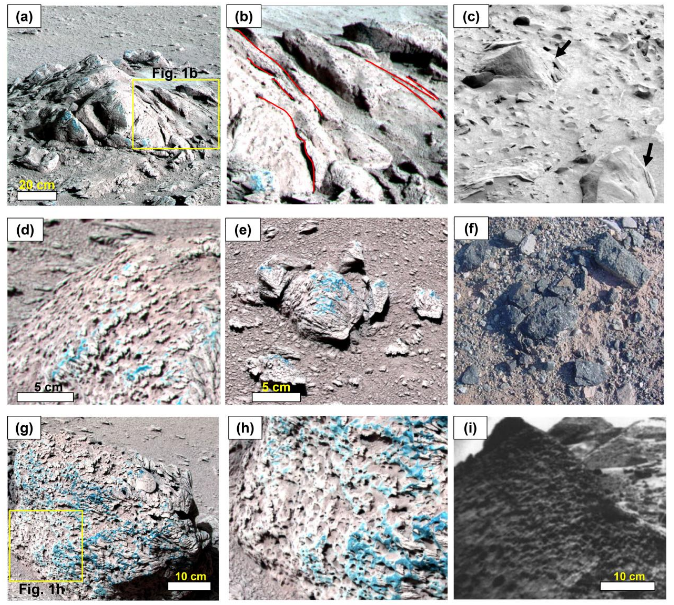
Salt weathering is a process in which soluble salts repeatedly dissolve and crystallize within rocks, gradually breaking down the rock structure. Under Mars’ current cold and arid conditions, however, the specific occurrence conditions and intensity of this process remain to be investigated.
The team conducted simulation analyses using on-site meteorological measurements from the Zhurong rover and the Mars climate database. The results show that from late spring to summer, near-surface temperatures and relative humidity during nighttime to pre-dawn hours intermittently approach the deliquescence thresholds of certain hygroscopic salts. This provides a theoretical basis for the formation of short-lived saline solutions during these periods.
Combining the above observations and simulations, the team proposes the following mechanism: Salt particles in Martian dust deposit and adsorb onto rock surfaces. Under suitable temperature and humidity conditions, these salts deliquesce to form trace brines. During subsequent evaporation, the salts recrystallize, and the resulting crystallization pressure gradually weakens and fractures the rock structure – ultimately shaping the surface textures observed by Zhurong.
This study indicates that even under the extremely cold and dry conditions of modern Mars, short-lived and weak surface modification processes can still occur near the surface. These processes are driven by salt hygroscopicity, crystallization, and related reactions. The work provides new observational evidence for understanding atmosphere-surface interactions on present-day Mars.